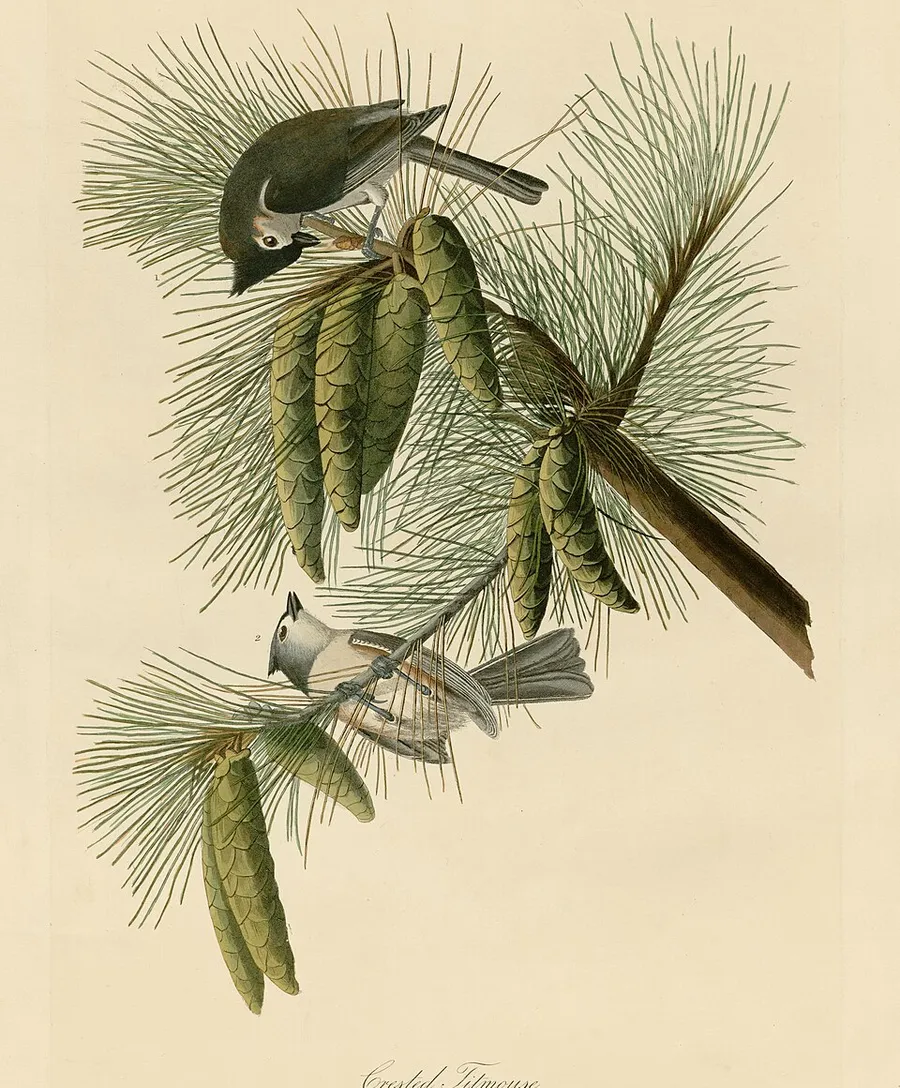
Tufted Titmouse
“I had assumed that this band of travelers was a mixed flock of Titmice and Chickadees until I caught a glimpse of the buttery yellow backside of a tiny creature darting into its shadowy hideaway.”
Through the year
Columns that mention it, by the month they were published.
Year by year
Columns that mention it each year.
In his words
Ten of the 30 passages, oldest first.
Good numbers of fledgling white-breasted nuthatches, tufted titmice and American goldfinches have been frequenting our feeders.
In the celebrated “from away” category are the Tufted Titmice, Red-bellied Woodpeckers and Eastern Bluebirds, all species that you would not have found here during the winter months in Cape fifty years ago, yet today are quite common.
Other noteworthy observations for late February and the first three days of March - strong numbers of House Finch (including one leucistic male), White breasted nuthatch and Tufted titmice on the backyard feeders.
Two song sparrows arrived on the seventeenth and joined the chorus of House finches, Pine finches, Gold finches, Titmice and Cardinals.
Other mentionables include: A female Common Eider teaching a gaggle of chicks to dive for crustaceans, several Swamp Sparrow fledglings - a Red bellied Woodpecker with three young continuing to devour our suet and Song Sparrow, Titmice and Chickadee fledglings are out and about as well.
On more than one occasion mixed flocks of vocal Black-capped Chickadees and Tufted titmice were tip-offs to other travels as well.
The threadlike high-pitched call notes of the Golden-crowned Kinglet rings through Robinson Woods and the chatter of Tufted Titmice and White-breasted Nuthatches busying themselves for the coming winter months is hard to ignore.
Through January our backyard feeders continue to attract solid numbers of House Finch, Tufted Titmice, Black-capped Chickadees, White-breasted Nuthatches, Mourning Doves, Downy, Hairy and Red-bellied woodpeckers and Cardinals.
Many local woodland species have been singing across Cape Elizabeth such as Tufted Titmice, Black-capped Chickadees, House Finches, Song Sparrows, Northern Cardinals and even Carolina Wrens.
Also, keep your eyes open for White-breasted Nuthatches, House Finches and Tufted Titmice who are all starting to build nests.
Show all 30 passages
On more than one occasion mixed flocks of vocal Black-capped Chickadees and Tufted titmice were tip-offs to other travels as well.
On the morning of July 3 five fledgling Baltimore Orioles and a Red-breasted Nuthatch managed to find room on our suet cage and were surrounded by an entourage of crying young - in particular, Red-bellied and Hairy Woodpeckers, Blue Jays and Tufted Titmice.
When trying to identify songbirds high up in trees it is important to get a good hold on several of the characteristic traits (movements and call notes) of the more common birds such as titmice, chickadees…
I had assumed that this band of travelers was a mixed flock of Titmice and Chickadees until I caught a glimpse of the buttery yellow backside of a tiny creature darting into its shadowy hideaway.
Was this a rare bird that I have never heard before or an abnormal vocalization from a common bird like a Tufted Titmouse?
In early October the chatter of Tufted Titmice, Black-capped Chickadees and White-breasted Nuthatches busying themselves for the coming winter months is hard to ignore.
Unlike the House Finches, titmice and nuthatches that took flight upon my presence, this bird lingered curiously before flying to a nearby tree branch.
Resident birds like Carolina Wrens, Tufted Titmice and the Bluebirds are now tending to rambunctious fledglings.
When trying to identify birds high up in trees or deep within thickets it is important to get a good hold on several of the characteristic traits (movements and call notes) of the more common birds such as Tufted Titmice, Black-capped Chickadees…
My brain raced with possibilities, was this a rare bird that I have never heard before or an abnormal vocalization from a common bird like a Tufted Titmouse?
Slightly smaller than a Tufted Titmouse, the Black-throated Green is more often heard than seen, especially at this time of year given its preference for sunlit tops of White Pine and other conifers.
In early October, our woodlands are filled with the chatter of Tufted Titmice, Black-capped Chickadees and nuthatches busying themselves for the coming winter months.
Interestingly, Cornell’s Merlin app stated that the calls were coming from a Cardinal and/or a Titmouse, but it sounded nothing like either bird and I had a strong hunch that it was something different.
White-throated Sparrows scratching, Cardinals glowing, Goldfinches clinging, Carolina Wrens creeping, House Finches and Chickadees singing, White Breasted Nuthatches whacking, Titmice fluttering, Doves perching and Bluebirds squabbling.
…the thin, silvery calls of Golden-crowned Kinglets deep within the forest, the way a Brown Creeper’s song calls to mind pine boughs sighing in the wind, the sweetly whistled Tufted Titmice tune that accompany the falling snow, the hurried winter song from the ever curious Carolina Wren couple…
Resident birds like Carolina, Wrens, Tufted Titmice and Eastern Bluebirds are further along and are now keeping close eyes on their rambunctious fledglings.
The last two weeks in my backyard have brimmed with activity—boisterous Tufted Titmouse fledglings, a second brood of Eastern Bluebirds, and young Baltimore Orioles and Rose-breasted Grosbeaks joining the mix.
Its shrill chirps gave it away as I had heard this same call months back and recalled the Merlin app had stated at the time the call in question was coming from a Titmouse.
…Dark-eyed Juncos chasing, White-throated Sparrows scratching, Cardinals glowing, Goldfinches clinging, Carolina Wrens creeping, House Finches and Chickadees dashing, White-breasted Nuthatches whacking, Titmice fluttering, Doves perching and Bluebirds watching.
Was this a rare visitor I had never encountered, or simply an odd vocalization from a familiar species like a Tufted Titmouse?