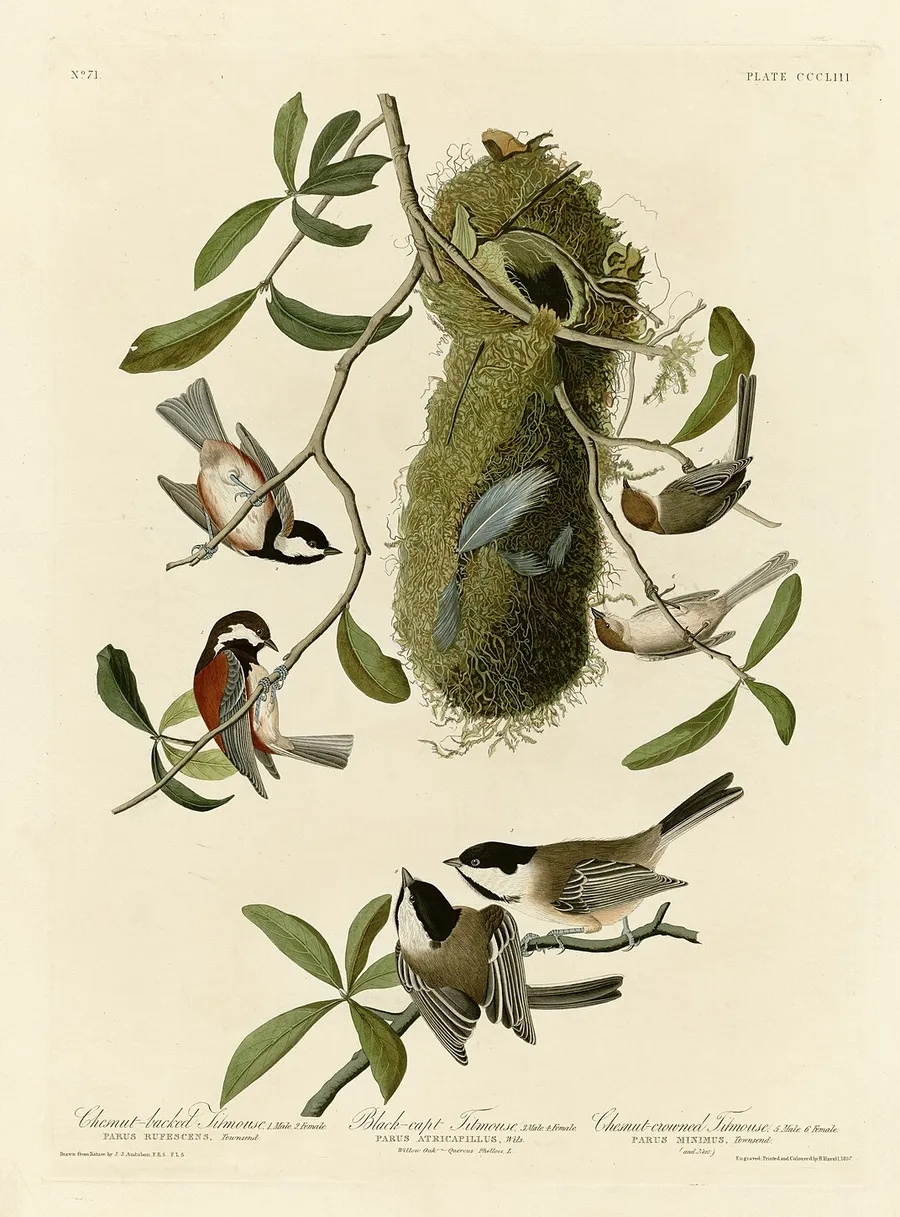
Black-capped Chickadee
“The Black-capped Chickadees’ feet keep from freezing by effectively transferring heat between outgoing and incoming veins, thus allowing for a continuous flow of blood while roosting or perching.”
Through the year
Columns that mention it, by the month they were published.
Year by year
Columns that mention it each year.
In his words
Ten of the 21 passages, oldest first.
A female Common Eider teaching a gaggle of chicks to dive for crustaceans, several Swamp Sparrow fledglings - Song Sparrow and Chickadee fledglings are out and about as well.
Slightly larger than a Chickadee, the Chipping sparrow has a bright rusty crown atop its head.
Other mentionables include: A female Common Eider teaching a gaggle of chicks to dive for crustaceans, several Swamp Sparrow fledglings - a Red bellied Woodpecker with three young continuing to devour our suet and Song Sparrow, Titmice and Chickadee fledglings are out and about as well.
On more than one occasion mixed flocks of vocal Black-capped Chickadees and Tufted titmice were tip-offs to other travels as well.
A small bird, brown above, speckled and streaked with whitish below, often tags along with a little group of woodland birds such as chickadees, nuthatches, kinglets and woodpeckers.
Through January our backyard feeders continue to attract solid numbers of House Finch, Tufted Titmice, Black-capped Chickadees, White-breasted Nuthatches, Mourning Doves, Downy, Hairy and Red-bellied woodpeckers and Cardinals.
Many local woodland species have been singing across Cape Elizabeth such as Tufted Titmice, Black-capped Chickadees, House Finches, Song Sparrows, Northern Cardinals and even Carolina Wrens.
I also saw and heard numerous Cedar Waxwings with young emerging from the thickets along the rocky shoreline and a young family of Black-capped Chickadees.
On more than one occasion mixed flocks of vocal Black-capped Chickadees and Tufted titmice were tip-offs to other travels as well.
A small bird, brown above, speckled and streaked with whitish below, often tags along with a little group of woodland birds such as chickadees, nuthatches, kinglets, and woodpeckers.
Show all 21 passages
This warbler’s presence, with a black cap and white-faced mask, (similar to a Chickadee) represents one of the most identifiable features of spring migration – signifying that the great vernal flight of wood sprites is coming to an end.
When trying to identify songbirds high up in trees it is important to get a good hold on several of the characteristic traits (movements and call notes) of the more common birds such as titmice, chickadees…
I had assumed that this band of travelers was a mixed flock of Titmice and Chickadees until I caught a glimpse of the buttery yellow backside of a tiny creature darting into its shadowy hideaway.
In early October the chatter of Tufted Titmice, Black-capped Chickadees and White-breasted Nuthatches busying themselves for the coming winter months is hard to ignore.
When trying to identify birds high up in trees or deep within thickets it is important to get a good hold on several of the characteristic traits (movements and call notes) of the more common birds such as Tufted Titmice, Black-capped Chickadees…
The Black-capped Chickadees’ feet keep from freezing by effectively transferring heat between outgoing and incoming veins, thus allowing for a continuous flow of blood while roosting or perching.
Slightly bigger than a chickadee, the bird stood out from its cousins the White Throated Sparrow and Dark-Eyed Junco with its slim, long-tailed look, chestnut cap and black stripe through the eye.
In early October, our woodlands are filled with the chatter of Tufted Titmice, Black-capped Chickadees and nuthatches busying themselves for the coming winter months.
White-throated Sparrows scratching, Cardinals glowing, Goldfinches clinging, Carolina Wrens creeping, House Finches and Chickadees singing, White Breasted Nuthatches whacking, Titmice fluttering, Doves perching and Bluebirds squabbling.
Slightly larger than a Chickadee, the Chipping Sparrow has a bright rusty crown atop its head.
As December settles in with snow and below average temperatures my backyard ebbs and flows with familiar winter activity: Dark-eyed Juncos chasing, White-throated Sparrows scratching, Cardinals glowing, Goldfinches clinging, Carolina Wrens creeping, House Finches and Chickadees dashing…