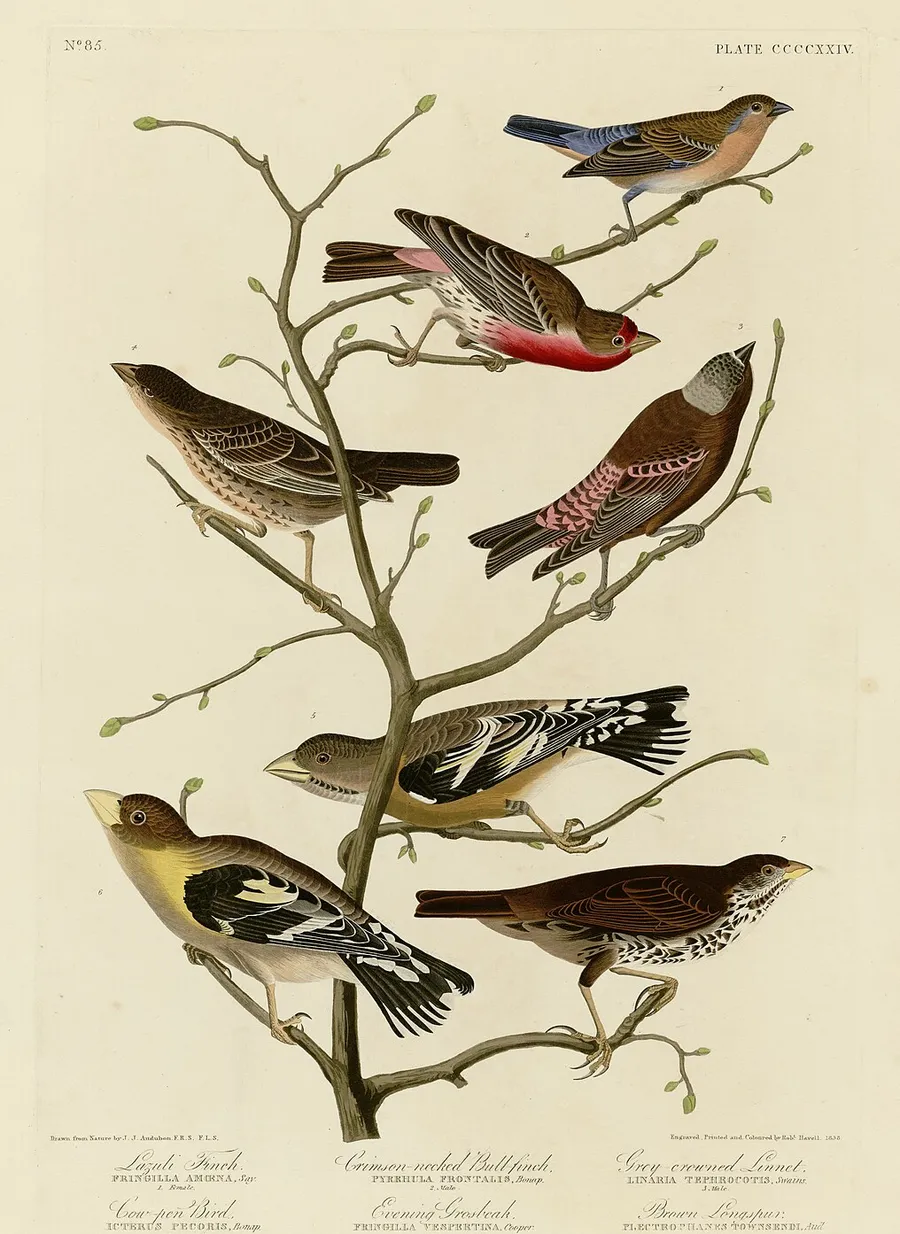
House Finch
“Unlike the House Finches, titmice and nuthatches that took flight upon my presence, this bird lingered curiously before flying to a nearby tree branch.”
Through the year
Columns that mention it, by the month they were published.
Year by year
Columns that mention it each year.
In his words
Ten of the 21 passages, oldest first.
Other noteworthy observations for late February and the first three days of March - strong numbers of House Finch (including one leucistic male), White breasted nuthatch and Tufted titmice on the backyard feeders.
Two song sparrows arrived on the seventeenth and joined the chorus of House finches, Pine finches, Gold finches, Titmice and Cardinals.
On Nov. 11, Veteran’s Day, I heard House Finches singing and a local Carolina Wren snooping about in the pachysandra berm.
Through January our backyard feeders continue to attract solid numbers of House Finch, Tufted Titmice, Black-capped Chickadees, White-breasted Nuthatches, Mourning Doves, Downy, Hairy and Red-bellied woodpeckers and Cardinals.
Many local woodland species have been singing across Cape Elizabeth such as Tufted Titmice, Black-capped Chickadees, House Finches, Song Sparrows, Northern Cardinals and even Carolina Wrens.
One reason sited for these birds being less numerous (at least with backyard sightings) is the increase in the more aggressive House Finch, which drive the Purple Finches deeper into our forests.
Also, keep your eyes open for White-breasted Nuthatches, House Finches and Tufted Titmice who are all starting to build nests.
On Veteran’s Day, I heard House Finches singing and I spied a Carolina Wren snooping about in the pachysandra berm.
Stepping outside on a bright, mild winter morning to be greeted by the cheery warbler of a rosy-red House Finch.
This boreal species has been driven deeper into the woods by the introduction of the more aggressive House Finch in 1939 and its population throughout southern Maine is in decline.
Show all 21 passages
…chickadees, House Finches and Goldfinches that also frequent the upper canopy and that can be easily confused with warblers and other songbirds.
…the sweet whistled Tufted Titmice notes that accompany the falling snow, the hurried winter song from the ever curious Carolina Wrens, the cheery warbler of rosy-red House Finches and the querulous chatter of five Eastern Bluebirds christening the new heated birdbath I had put out the night before.
Also, amongst the House Finches and molting Goldfinches I spotted a female Indigo Bunting in our backyard.
I also appreciate the daily visits to our backyard by North Flickers and a male Pileated Woodpecker along with bluebirds and house finches that spread cheery chatter.
Unlike the House Finches, titmice and nuthatches that took flight upon my presence, this bird lingered curiously before flying to a nearby tree branch.
…Black-capped Chickadees, House Finches and Goldfinches that are often times intermingling with warblers and other songbirds.
White-throated Sparrows scratching, Cardinals glowing, Goldfinches clinging, Carolina Wrens creeping, House Finches and Chickadees singing, White Breasted Nuthatches whacking, Titmice fluttering, Doves perching and Bluebirds squabbling.
…the hurried winter song from the ever curious Carolina Wren couple, the cheery warbler of rosy-red House Finches, the low sweet melodies sung by Dark-eyed Juncos, and the querulous chatter of five Eastern Bluebirds socializing around the birdbath on a shivery morning.
This boreal species has been driven deeper into the woods by the introduction of the more aggressive House Finch in 1939 and its population throughout southern Maine is in decline.
I like to think of them as miniature female Rose-breasted Grosbeaks, though they’re more often mistaken for House Finches.
As December settles in with snow and below average temperatures my backyard ebbs and flows with familiar winter activity: Dark-eyed Juncos chasing, White-throated Sparrows scratching, Cardinals glowing, Goldfinches clinging, Carolina Wrens creeping, House Finches and Chickadees dashing…