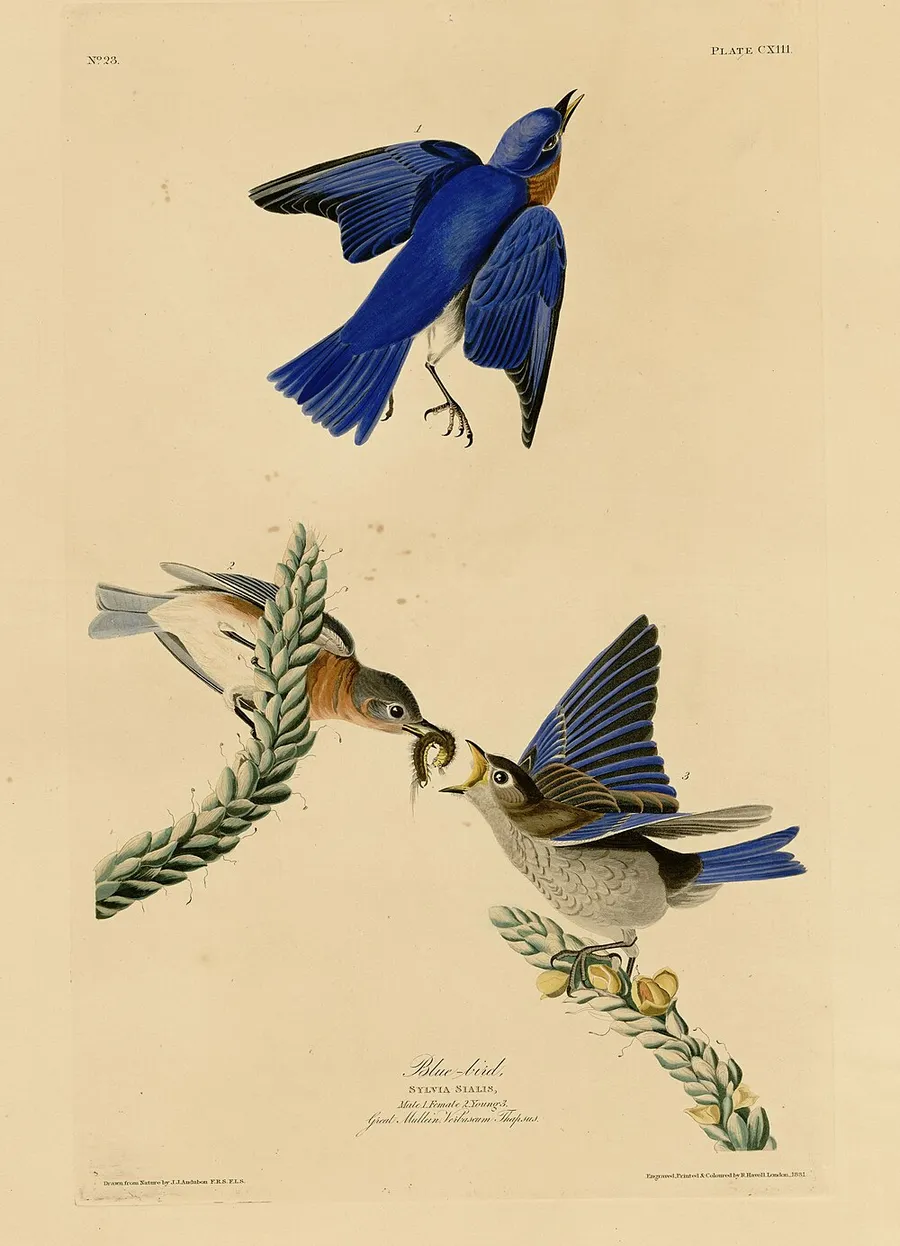
Eastern Bluebird
“Bluebird in size, their snow-white underparts contrast with black wing tips and rufous overtones.”
Through the year
Columns that mention it, by the month they were published.
Year by year
Columns that mention it each year.
In his words
Ten of the 41 passages, oldest first.
Impressive numbers of non-migratory Eastern Bluebirds have made it through another winter.
Eastern Bluebirds have begun to court from one end of Shore Road to the other - noticeably chatty this time of year.
I am also very pleased to report that the bluebird box that I had built two springs ago (last season the bluebirds checked it out but never nested) has young bluebirds in it as of August 19.
To my delight a pair of resident bluebirds with their new son dropped in to teach the young bird how to navigate a suet cage.
Bluebird in size, their snow-white underparts contrast with black wing tips and rufous overtones.
Our resident foursome of bluebirds disappeared for a couple days during the end of 2018 but re-appeared just as the snow started to come down on January 3.
In the celebrated “from away” category are the Tufted Titmice, Red-bellied Woodpeckers and Eastern Bluebirds, all species that you would not have found here during the winter months in Cape fifty years ago, yet today are quite common.
My first observations were of birds that were smaller than American robins but seemingly larger than Eastern bluebirds.
June 20 brought the return of our resident Eastern Bluebirds to our yard after being absent for the first time in a couple of weeks.
Adding to the fun, a pair of resident bluebirds with their new son dropped in to teach the young bird how to navigate the suet cage.
Show all 41 passages
On Nov. 9, I observed two bluebirds giving playful chase to a nearly crow sized Pileated Woodpecker.
Bluebird in size, their snow-white underparts contrast with black wing tips and rufous overtones.
Other mentionables include, nomadic flocks of 50 or more Robins, Common Ravens, Carolina wrens, Eastern bluebirds, a single Northern mockingbird (Pond Cove) and daily yard visits from Coopers hawks.
…new research from the Journal of Applied Ecology from the University of Connecticut discovered that the seasonal feeding (live mealworms were used ) of Eastern Bluebirds in our backyards during breeding season increases young birds immune response to a type of parasitic fly larvae that feed on the blood of the…
Additionally, for the second straight year in a row our resident pair of Bluebirds has decided to nest in the Downy woodpecker cavity in the side of our house.
More from our yard, the local bluebirds have re-used the woodpecker cavity in the side of our house for the second straight season.
On November 9, I observed four resident bluebirds giving playful chase to a nearly crow-sized male Pileated Woodpecker (males have a red stripe on their cheek).
On the windy bluebird day of February 21 my wife, son and I were exploring the farmost fringes of a frozen over Great Pond and spotted an immature light-phased Rough-legged Hawk.
As for my local patch, the Carolina Wrens and the Bluebirds that nested within ten feet of each other (wrens in my overturned canoe and bluebirds in the side of the house) both fledged two chicks each by May 16.
Within a half hour time span I also heard five different types of thrushes singing - Eastern Bluebird, Veery, Hermit Thrush, Wood Thrush and American Robin.
And to a sligltly lesser extent, Northern Flickers, Eastern Bluebirds and Carolina Wrens.
Also of note, this is the fourth winter in a row that two Carolina Wrens and three Eastern Bluebirds have decided to spend the winter with us.
…the sweet whistled Tufted Titmice notes that accompany the falling snow, the hurried winter song from the ever curious Carolina Wrens, the cheery warbler of rosy-red House Finches and the querulous chatter of five Eastern Bluebirds christening the new heated birdbath I had put out the night before.
These birds (slightly bigger than bluebirds) were heard excavating for seed and insects in the leaf litter from twenty five yards away!
The Eastern Phoebes nesting in the eaves above our front door have recently fledged and two separate pairs of Bluebirds nesting in woodpecker cavities along the side of our house both have noisy broods.
In the first week of December, I was delighted to see three Red-breasted Nuthatches, a Northern Flicker and an Eastern Bluebird on my tail prop suet station.
I also appreciate the daily visits to our backyard by North Flickers and a male Pileated Woodpecker along with bluebirds and house finches that spread cheery chatter.
Larger than a Bluebird or Song Sparrow this rather robust sparrow sports a uniform reddish-chestnut cloak and a clear, full, and flutelike song.
Resident birds like Carolina Wrens, Tufted Titmice and the Bluebirds are now tending to rambunctious fledglings.
The bluebirds that have been a constant on our property for over five years have disappeared and my feeders (including the mealworm lodge) are taking three times as long to reach empty.
Bluebird in size, their snow-white underparts contrast nicely with black wing tips and rufous overtones.
Two separate pairs of Bluebirds nesting in woodpecker cavities along the side of our house both have noisy broods though.
As for observations from the yard and field, on November 16 while doing one last scan of the gravel sections of parking lot within Crescent Beach State Park I noticed a flash of white as several bluebird sized birds briefly rose up in the air then seemingly disappeared.
White-throated Sparrows scratching, Cardinals glowing, Goldfinches clinging, Carolina Wrens creeping, House Finches and Chickadees singing, White Breasted Nuthatches whacking, Titmice fluttering, Doves perching and Bluebirds squabbling.
…the hurried winter song from the ever curious Carolina Wren couple, the cheery warbler of rosy-red House Finches, the low sweet melodies sung by Dark-eyed Juncos, and the querulous chatter of five Eastern Bluebirds socializing around the birdbath on a shivery morning.
Slightly larger than a bluebird and with a uniform comprised of rich rusty-chestnut and white with broad spots and streaks below, this bird is one of sparrows that scratches the ground with two feet at once.
Resident birds like Carolina, Wrens, Tufted Titmice and Eastern Bluebirds are further along and are now keeping close eyes on their rambunctious fledglings.
The last two weeks in my backyard have brimmed with activity—boisterous Tufted Titmouse fledglings, a second brood of Eastern Bluebirds, and young Baltimore Orioles and Rose-breasted Grosbeaks joining the mix.
…Dark-eyed Juncos chasing, White-throated Sparrows scratching, Cardinals glowing, Goldfinches clinging, Carolina Wrens creeping, House Finches and Chickadees dashing, White-breasted Nuthatches whacking, Titmice fluttering, Doves perching and Bluebirds watching.
Bluebird in size, their snow-white underparts contrast with black wing tips and rufous overtones.
Four first year bluebirds bathed in the birdbath, and a giant formation of Double crested Cormorants flew overhead.