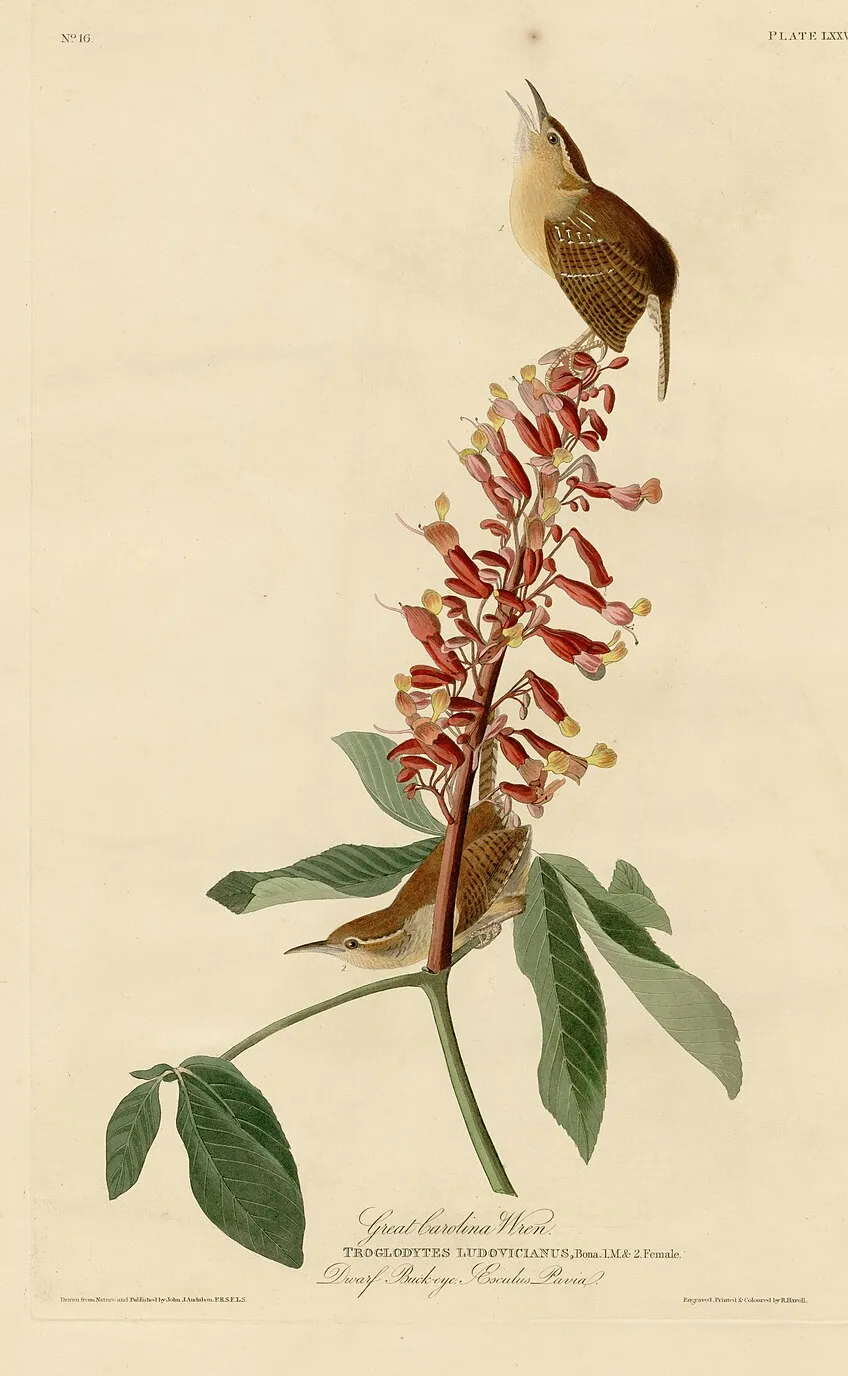
Carolina Wren
“Unlike our migratory little House and Winter Wrens, the Carolina Wren will often spend the winter in the same territory it had previously nested in.”
Through the year
Columns that mention it, by the month they were published.
Year by year
Columns that mention it each year.
In his words
Ten of the 37 passages, oldest first.
Noteworthy indeed is the local population of Carolina wrens, seen and heard in Pond Cove, along Julie Ann Lane, Gull Crest, Cranbrook and a duetting pair on Hannover Cove Road!
A single carolina wren has just started to visit our yard.
A young female Carolina wren briefly made herself known within the thickets of Pond Cove.
Other notables include: Surf and White-winged Scoters have arrived just offshore, a Yellow-bellied Sapsucker, two Northern Parula’s and a female Nashville Warbler playing hide-and-go-seek, and one of my most favorite adaptable dwellers of our forestlands ,a single chattering Carolina wren.
Other notables include two Carolina wrens at our mealworm station (as a side note, this is the first time in several years that I have seen two such birds in the same patch together).
Throughout early January we have been fortunate enough to be host to two Carolina wrens.
Our beloved resident Carolina wren couple were tea-kettling up a storm.
The intermingled songs of both the House Wren and Carolina Wren can be heard in many of our neighborhoods, including Cranbrook, Delano Park and Winnick Woods.
During the last days of July, we had a new family of boisterous Carolina Wrens pass through our property.
Another noteworthy mentioning on September 1 included, discovering a Carolina Wren’s nest under my canoe alongside our house (with four newly hatched young).
Show all 37 passages
Every fall now the bluebirds start to get more territorial, guarding the mealworm “lodge” from pesky intruders like the family of four Carolina wrens.
On Nov. 11, Veteran’s Day, I heard House Finches singing and a local Carolina Wren snooping about in the pachysandra berm.
Other mentionables include, nomadic flocks of 50 or more Robins, Common Ravens, Carolina wrens, Eastern bluebirds, a single Northern mockingbird (Pond Cove) and daily yard visits from Coopers hawks.
Many local woodland species have been singing across Cape Elizabeth such as Tufted Titmice, Black-capped Chickadees, House Finches, Song Sparrows, Northern Cardinals and even Carolina Wrens.
Starting in early June the intermingled songs of both the House Wren and Carolina Wren can be heard in many of our neighborhoods, including Brentwood, Cranbrook, Delano Park and Winnick Woods.
On Veteran’s Day, I heard House Finches singing and I spied a Carolina Wren snooping about in the pachysandra berm.
Other noteworthy mentionings in February: a Red-breasted Nuthatch, Brown Creeper, a male and female Carolina Wren, and a solitary Pine Siskin all in the same old Crab apple tree in my yard on February 24.
On March 13 the Carolina Wren couple that stayed with us over the winter were singing a duet as they explored nesting locations (including our overturned canoe) around the house.
As for my local patch, the Carolina Wrens and the Bluebirds that nested within ten feet of each other (wrens in my overturned canoe and bluebirds in the side of the house) both fledged two chicks each by May 16.
And to a sligltly lesser extent, Northern Flickers, Eastern Bluebirds and Carolina Wrens.
Also of note, this is the fourth winter in a row that two Carolina Wrens and three Eastern Bluebirds have decided to spend the winter with us.
In the first few days of January, I am thankful for Golden-crowned Kinglets and Brown Creepers, the sweet whistled Tufted Titmice notes that accompany the falling snow, the hurried winter song from the ever curious Carolina Wrens…
Slightly smaller than a House wren and less hardy than its cousin the Carolina Wren, this absurd little creature habitually holds its stubby tail straight up while bouncing to and fro.
Slightly larger than a robin, this secretive bird has an endless array of unique songs interspersed between mimicry of many other birds including Kingfishers, Goldfinches, Scarlet Tanagers and Carolina Wrens.
…I am thankful for many things, including the fine sweet trill of Red-breasted Nuthatches, the way a Brown Creeper’s song calls to mind pine boughs sighing in the wind or the low sweet melodies sung by Dark-eyed Juncos and the hurried winter song from ever the curious Carolina Wren couple.
On this same day the Carolina Wren couple that had spent the winter with us were singing a duet as they explored nesting locations around the yard.
Slightly smaller than a House Wren and less hardy than its cousin the Carolina Wren, this absurd little creature habitually holds its stubby tail straight up while darting to and fro.
Resident birds like Carolina Wrens, Tufted Titmice and the Bluebirds are now tending to rambunctious fledglings.
Observing the bird for a couple of minutes I could not help but notice that the Thrasher’s movements were often similar to the Carolina Wrens in yard.
Upon entering the room, I immediately noticed that there was a Carolina Wren sitting atop the lampshade on my bedside table!
Unlike our migratory little House and Winter Wrens, the Carolina Wren will often spend the winter in the same territory it had previously nested in.
Or stepping outside on a bright, February morning to be greeted by the chattering of a Carolina Wren while the trilled bzeee whistles of Cedar Waxing’s ebb and flow across the leafless upper canopies.
White-throated Sparrows scratching, Cardinals glowing, Goldfinches clinging, Carolina Wrens creeping, House Finches and Chickadees singing, White Breasted Nuthatches whacking, Titmice fluttering, Doves perching and Bluebirds squabbling.
…the hurried winter song from the ever curious Carolina Wren couple, the cheery warbler of rosy-red House Finches, the low sweet melodies sung by Dark-eyed Juncos, and the querulous chatter of five Eastern Bluebirds socializing around the birdbath on a shivery morning.
The Marsh Wren, similar in stature to the House Wren, nestles between the larger Carolina Wren and the diminutive Winter Wren.
As December settles in with snow and below average temperatures my backyard ebbs and flows with familiar winter activity: Dark-eyed Juncos chasing, White-throated Sparrows scratching, Cardinals glowing, Goldfinches clinging, Carolina Wrens creeping, House Finches and Chickadees dashing…
The Marsh Wren, similar in stature to the House Wren, nestles between the larger Carolina Wren and the diminutive Winter Wren.