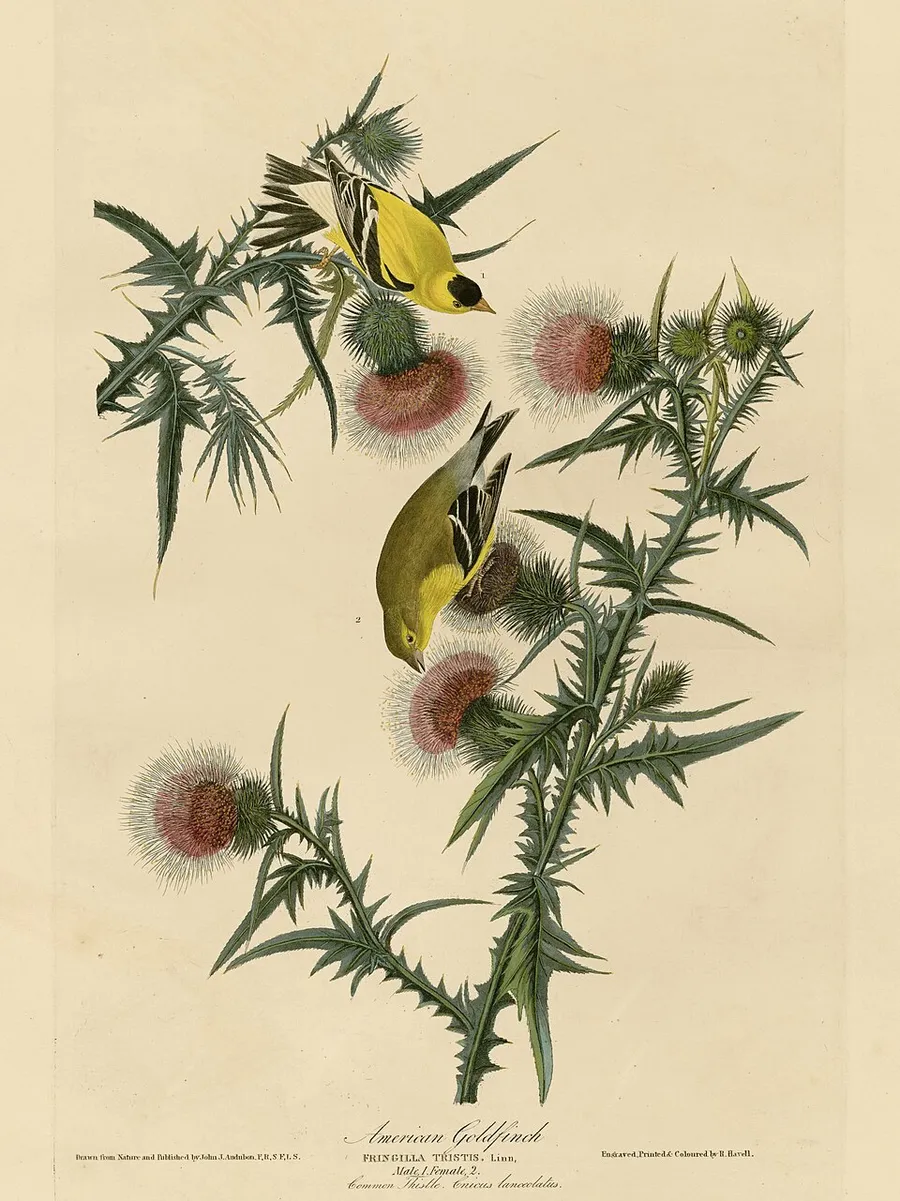
American Goldfinch
“A goldfinch in disguise, the constantly atwitter Spinus pinus is similar in size and shape to that of our resident American Goldfinch but its bill is longer and slimmer.”
Through the year
Columns that mention it, by the month they were published.
Year by year
Columns that mention it each year.
In his words
Ten of the 27 passages, oldest first.
Good numbers of fledgling white-breasted nuthatches, tufted titmice and American goldfinches have been frequenting our feeders.
These very active little birds are similar in shape to that of a Goldfinch, but their bills are longer and slimmer.
I’ve noticed that the American Goldfinches get to the tube earlier (before sunrise) than the Pine Siskin’s do.
Two song sparrows arrived on the seventeenth and joined the chorus of House finches, Pine finches, Gold finches, Titmice and Cardinals.
American Goldfinches have been plucking nesting material from the ball of alpaca fiber I put outside in a crab apple tree and my mother-in-law on Two Lights Road reports that Cedar Waxwings made quick work of the nesting ball she had out as well.
Later that same day I spotted a female American Goldfinch with nesting material.
These very active little birds are similar in size and shape to that of a Goldfinch, but their bills are longer and slimmer.
On January 19 I counted 23 Goldfinches on our niger tube and around dusk I counted eight bright red males and three female Cardinals present.
As for late summer nesters, on August 2 while in Two Lights State Park I caught glimpses of several American Goldfinches with nesting material in their beaks.
A goldfinch in disguise, the Pine Siskin is similar in size and shape to that of our resident American Goldfinch, however its bill is longer and slimmer.
Show all 27 passages
Also, on September 8 a male Blackpoll Warbler appeared at our birdbath, and on September 10 a bright male Yellow Warbler dropped in and shared a drink alongside a rather drab male Goldfinch.
…chickadees, House Finches and Goldfinches that also frequent the upper canopy and that can be easily confused with warblers and other songbirds.
Slightly larger than a robin, this secretive bird has an endless array of unique songs interspersed between mimicry of many other birds including Kingfishers, Goldfinches, Scarlet Tanagers and Carolina Wrens.
Also, amongst the House Finches and molting Goldfinches I spotted a female Indigo Bunting in our backyard.
Other mentionings from both the field and yard include my only winter finch sighting of the month on January 13, a single Pine Siskin that showed up to our thistle feeder amongst a company of American Goldfinches.
Purple Finches can imitate songs from Barn Swallows, Goldfinches, Towhees and even Cowbirds.
…Black-capped Chickadees, House Finches and Goldfinches that are often times intermingling with warblers and other songbirds.
A goldfinch in disguise, the constantly atwitter Spinus pinus is similar in size and shape to that of our resident American Goldfinch but its bill is longer and slimmer.
These very active little winter wanderers are similar in size and shape to that of a Goldfinch.
As of January 7 our yard consistently has twenty or more of both species along with a steadily increasing charm of twenty-six hungry Goldfinches.
Later in the afternoon two Pine Siskins stopped in and joined seventeen molting Goldfinches on the finch tube.
On most days, high up in the Oak Trees I can hear the pair’s wheezy trills and “watch winding” call intermingled with the Goldfinches’ twitters and warblers.
On late spring afternoons I have cherished their wheezy z-zing trills intermingled with the Goldfinches twitters and warblers.
Additionally, on September 16 I came across three cheery Blue-headed Vireos along the northern entrance to Runaway Farm and on September 20 in my backyard I noted a twenty-seven American Goldfinches, a continuing Ruby-throated Hummingbird and separately two Gray Catbirds, two Red-eye Vireos and a Philadelphia Vireo.
White-throated Sparrows scratching, Cardinals glowing, Goldfinches clinging, Carolina Wrens creeping, House Finches and Chickadees singing, White Breasted Nuthatches whacking, Titmice fluttering, Doves perching and Bluebirds squabbling.
As December settles in with snow and below average temperatures my backyard ebbs and flows with familiar winter activity: Dark-eyed Juncos chasing, White-throated Sparrows scratching, Cardinals glowing, Goldfinches clinging, Carolina Wrens creeping, House Finches and Chickadees dashing…
On September 18, twenty two goldfinches crowded the tube feeder, many of which have shed their bright yellow summer feathers, others in varying stages of molting into a more drab olive brown coat—a seasonal adaptation for camouflage, energy conservation and survival.