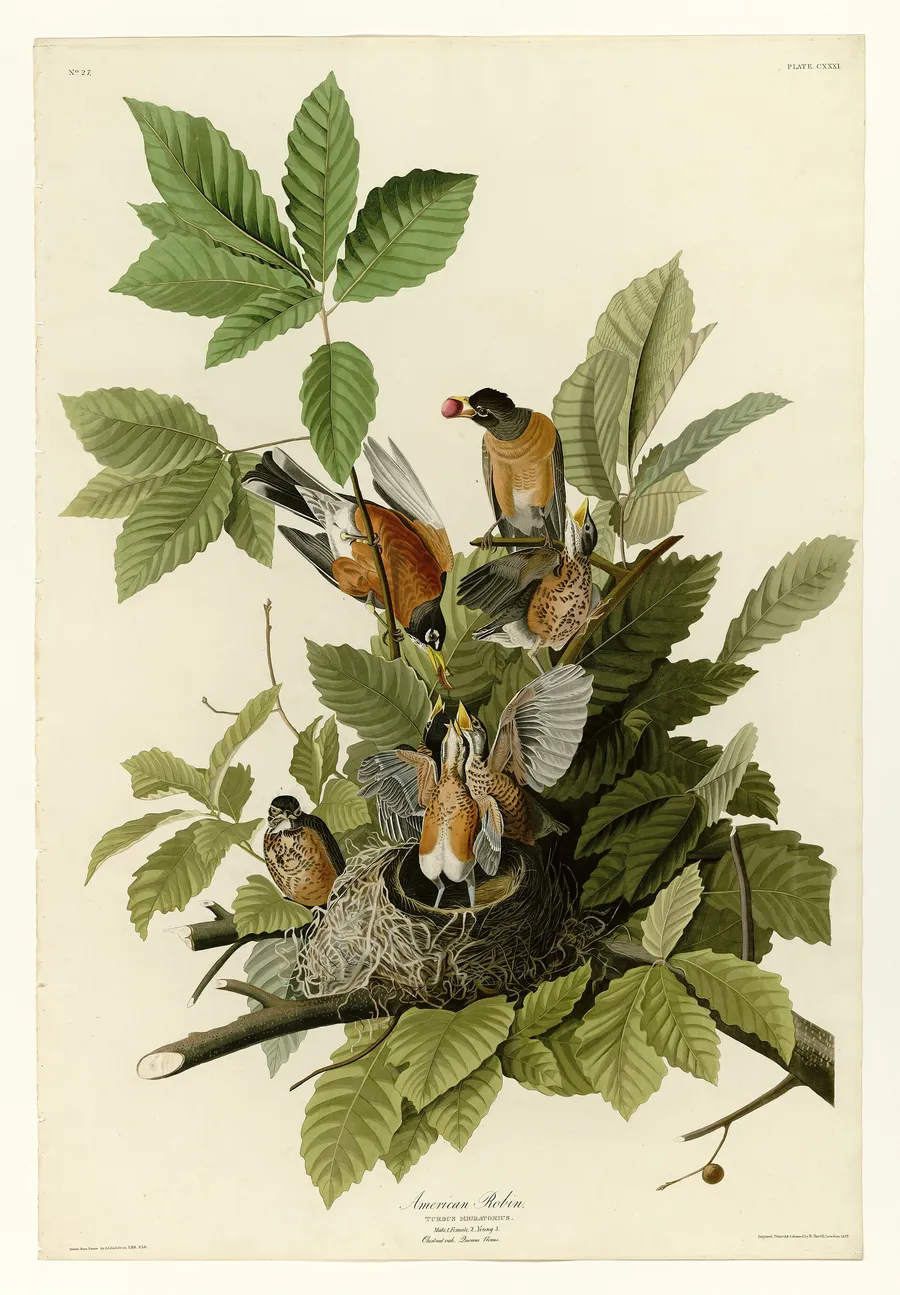
American Robin
“American Robins are also very visible and on the move as they begin to flock together to explore new territories during the daylight hours.”
Through the year
Columns that mention it, by the month they were published.
Year by year
Columns that mention it each year.
In his words
Ten of the 39 passages, oldest first.
On January 6, a nomadic flock of 100 or more American Robins cascaded through our backyard.
My first observations were of birds that were smaller than American robins but seemingly larger than Eastern bluebirds.
There have been some definite rays of sunlight over the last two weeks however, with pockets of migrants here and there, and our Robins and Cardinals are singing right through dusk most every day now.
Other mentionables include, nomadic flocks of 50 or more Robins, Common Ravens, Carolina wrens, Eastern bluebirds, a single Northern mockingbird (Pond Cove) and daily yard visits from Coopers hawks.
American Robins seem to be everywhere as well, and although considered harbingers of spring, this bird of the Thrush family often winters across its breeding range (including Cape).
Slightly bigger than a Robin this bird is the smallest of American terns and its populations are endangered in many areas of the U.S. because of the increased impact on nesting areas (beaches) where predation and harassment by unbridled dogs is still rampant.
Slightly larger than a Robin, the cuckoo bird is a bellwether of summer.
American Robins are also very visible and on the move as they begin to flock together to explore new territories during the daylight hours.
Sitting upright like a bird of prey, the sharp-eyed butcher descends, attacking birds of the same size such as Robins and Blue Jays and often “preserving” its catch by suspending victims on a nail or between the fork of two branches.
This neotropical bird’s song is reminiscent of an American Robin’s but with harsher “call notes” interspersed throughout.
Show all 39 passages
Visibly smaller than a Robin but bigger than an Eastern Phoebe, the Eastern Kingbird prefers to breed at the intersection of overgrown meadows, forest edges and ponds.
The highest concentrations of reported illnesses are with Robins, Blue Jays and Common Grackles.
Additionally, American Robins have been very visible and, on the move, as they begin to flock together to explore new territories during the daylight hours.
Other observations include American Robins passing overhead across Cape in groups ranging from a few individuals to several hundred as they wander in search of food.
About the length of Robins but with longer wings, Whip-poor-wills lay their eggs in phase with the lunar cycle, so that they hatch when the moon is nearly full.
Slightly larger than a robin, this secretive bird has an endless array of unique songs interspersed between mimicry of many other birds including Kingfishers, Goldfinches, Scarlet Tanagers and Carolina Wrens.
While the female incubates the male feeds her and when he is relieved of this duty he stands guard over the nest, often singing his long sing-songing string of sweet whistles which sound like an American Robin’s song but is more pleasing to the ear.
Still conspicuously calling in late July were Hermit Thrushes, Eastern Wood-pewees, Great-crested Flycatchers, Eastern Kingbirds, Red-eyed Vireos, Gray Catbirds and Robins.
Slightly smaller than a robin but of similar shape, these “Rusties” typically depart northern boreal forests where they breed by early-mid September…
By common I do not mean that this raptor may be seen as often as that of a Robin.
Male Scarlet Tanagers sing a song that is like that of an American Robin, albeit it sounds more rushed.
The latter sandpiper is a medium-sized, stout shorebird that is about the size of a robin and has a rather long, noticeably thick bill and long wings.
Fully two inches longer than a Robin and with a speckled breast, bright yellow eyes and a heavy, slightly downcurved bill, the ever secretive foxy-red Thrasher uses its bill to boldly forage in the soil for food.
Slightly smaller than a robin but of similar shape, these birds typically depart northern boreal forests where they breed by mid-September…
The bird was roughly the same size as a Robin with mottled rusty brown and blackish plumage and a black bill and feet.
The Pectoral Sandpiper is a stout shorebird that is about the size of a robin and has a rather long, noticeably thick bill and long wings.
Male Scarlet Tanagers sing a song that is like that of an American Robin, albeit it sounds more rushed.
A large sparrow-like ground nesting bird that can be mistaken for a robin, the Towhee is a bird of special concern in Maine, and over the last fifty years the species’ population has seen an alarming decline.
Described as a straggler and casual spring vagrant (meaning that it is quite rare) to Maine, this distinctive, tall but lean, small-bodied shorebird is somewhere between a robin and a crow in size.
Male Scarlet Tanagers sing a song that is like that of an American Robin, albeit it sounds more rushed.
Slightly smaller than a Robin but larger than an Eastern Phoebe, the Eastern Kingbird favors breeding sites where overgrown meadows meet forest edges and ponds.
Barely larger than a robin, this “Little Auk” or “little Ice-Bird” is instantly recognizable: glossy bluish-black above, white below and shaped almost like a football in flight.
Slightly larger than a robin, the Virginia Rail has a thin body, long reddish orange bill, rich cinnamon underparts, gray cheeks, sharply barred flanks, and long toes adapted for pushing through thick vegetation.
Their song resembles an American Robin’s but with sharper call notes woven through.
The song of a male Scarlet Tanager recalls that of an American Robin, though more hurried and urgent in delivery.
Another recent observation has centered on our early morning songsters: Catbirds, Robins, Eastern Phoebes, Cardinals, and Chipping Sparrows.
Slightly longer than a robin, the Yellow billed Cuckoo is distinguished from its cousin, the Black billed Cuckoo, by reddish flight feathers and black tail feathers marked with large white spots.
Elusive yet fascinating, this robin sized member of the sandpiper family blends seamlessly into wet meadows, marshlands and bogs.
Meanwhile, a robin sized Solitary Sandpiper foraged along the muddy bank below.