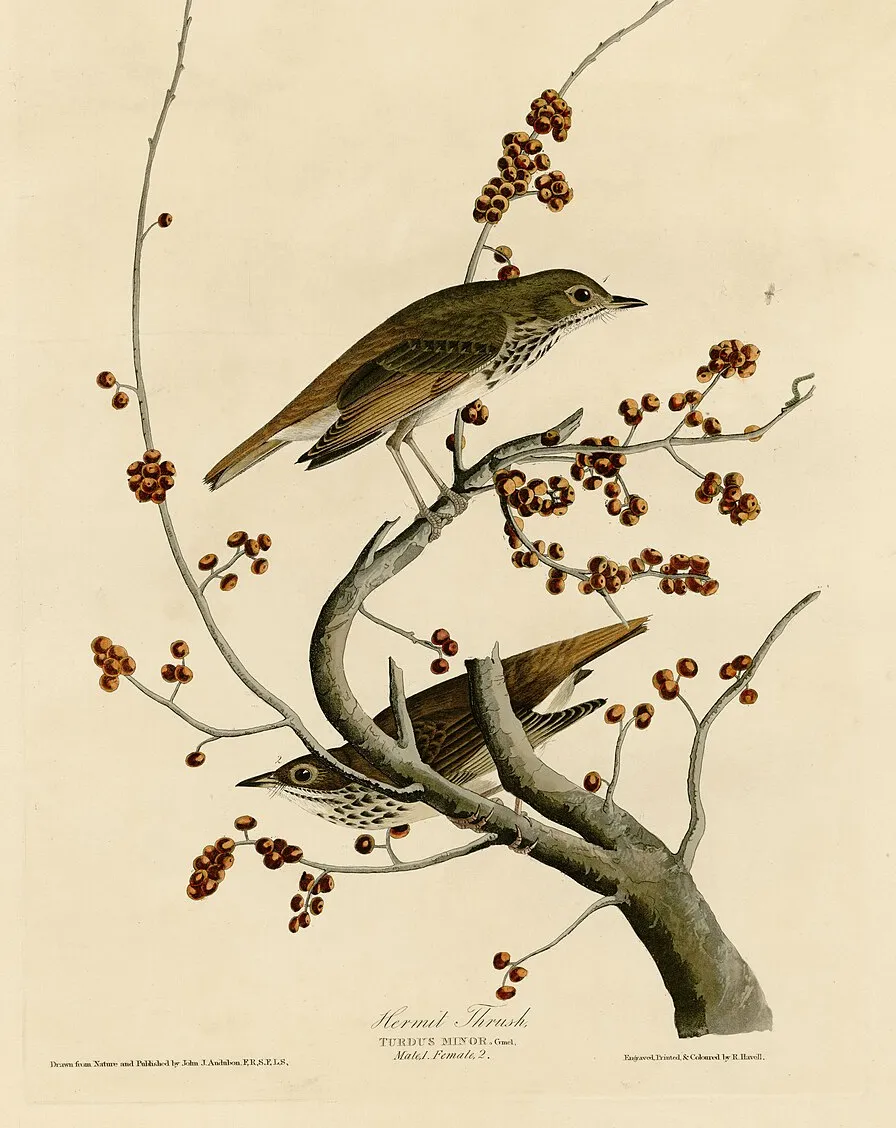
Hermit Thrush
“As the wren performed, three Hermit Thrushes emerged from the ground, perched low in young white spruce trees, and observed this absurd little dance.”
Through the year
Columns that mention it, by the month they were published.
Year by year
Columns that mention it each year.
In his words
Ten of the 30 passages, oldest first.
I also heard Wood Thrushes, Veery’s and Hermit Thrushes calling consistently across the Greenbelt system.
Great-crested Flycatchers and Hermit Thrushes were abundant here during the first couple weeks of the month.
Hermit Thrushes are still around too.
In the early morning hours of Jan 17 a very cold looking Hermit Thrush was seen in a Winterberry bush along Shore road.
On an equally impressive note, a walk-through Great Pond Preserve II yielded at least 50 Hermit thrushes.
The breezy ethereal song of the Veery can be still be heard from dawn to dusk, as can the Hermit Thrush’s wavering pitch and prominent overtones.
Other noteworthy mentioning’s include the First of Year (FOY) Hermit Thrush, Swamp Sparrow and Pine Warbler on April 11 in Robinson Woods III.
Pine warblers are settling into our wooded areas and at dusk the hauntingly beautiful song of the Hermit Thrush can be heard.
One way to tell the difference between this bird and the more commonly seen Hermit Thrush is to carefully observe the bold black spots across its underparts.
On one outing I caught a glimpse of a Wood Thrush and heard the wavering pitch and prominent overtones of a Hermit Thrush.
Show all 30 passages
As the wren performed, three Hermit Thrushes emerged from the ground, perched low in young white spruce trees, and observed this absurd little dance.
Within a half hour time span I also heard five different types of thrushes singing - Eastern Bluebird, Veery, Hermit Thrush, Wood Thrush and American Robin.
On October 23 a Hermit Thrush was spotted in this same shrub and later that morning my first of the season Golden Crowned Kinglet was spotted in a dead crab apple tree on our property.
The first thrush to come and the last thrush to go is the Hermit Thrush.
Later in the day I travelled across Robinson woods I, II and III and was treated to a chorus of Hermit Thrushes, several singing Winter Wrens and a single calling Ovenbird.
Lastly, on July 11, a Winter Wren, several Hermit Thrushes and a Ovenbird sang simultaneously at close range, deep within Robinson Woods while a Eastern Wood-Pewee whistled from its sunny perch within the mid-canopy.
Still conspicuously calling in late July were Hermit Thrushes, Eastern Wood-pewees, Great-crested Flycatchers, Eastern Kingbirds, Red-eyed Vireos, Gray Catbirds and Robins.
A good tangle of invasives near a stream is always an ideal spot from a Hermit Thrush’s perspective.
The following day in Two Lights State Park I came across a Hermit Thrush in one of the denser thicket areas and observed three Harlequin Ducks working the rough water along the rocky coastline.
On first day of June within the dark forest interior of Robinson Woods I was treated to a dusk chorus of Veery’s, Hermit Thrushes, a Winter Wren, Black-throated Green Warblers, Ovenbirds, Redstarts and Northern Parulas.
Stepping deeper into the shadowy forest, the pulsing songs from Ovenbirds intertwine with the delicate notes of a Hermit Thrush and several Veeries.
I was also treated to the songs of Veery’s, Hermit Thrushes, Great-crested Flycatchers, Cedar Waxwings and a single and Wood Thrush and Least Flycatcher.
I also spotted my first Brown Thrasher of the season crossing Two Lights Road and later that afternoon spied five Ruby-crowned Kinglets, two Savannah Sparrow, a Hermit Thrush and a single Eastern Towhee along the splendid little Greenbelt Trail tucked along the western side of the Riverside Cemetery.
As I walked deeper into the woods the enchanting tunes of Veerys and Hermit Thrushes intermingled with the flamboyant outbursts of a Winter Wren.
A late in the Season Hermit Thrush!
Additional observations include: on February 9 a Hermit Thrush in Kettle Cove and along Crescent Beach State Park, eight Long-tailed Ducks, six Buffleheads, four Red-breasted Mergansers and two Lesser Scaup ducks.
The following day I was treated to a pre dusk chorus of Veerys, Hermit Thrushes, a Winter Wren, Black-throated Green Warblers and Ovenbirds.
And within just a half an hour, the woods along this stretch of road came alive with the voices of five different thrushes—Eastern Bluebird, Veery, Hermit Thrush, Wood Thrush and American Robin.
On April 22, while admiring the steady trill of Pine Warblers in Robinson Woods III, Hermit Thrushes slipped through the underbrush and a northbound Great Blue Heron bellowed somewhere overhead.
Lastly, on more than one occasion in late July, while walking through Robinson Woods II and III, I was greeted by the measured songs of the Winter Wren accompanied by Black-throated Green Warblers and Hermit Thrushes.