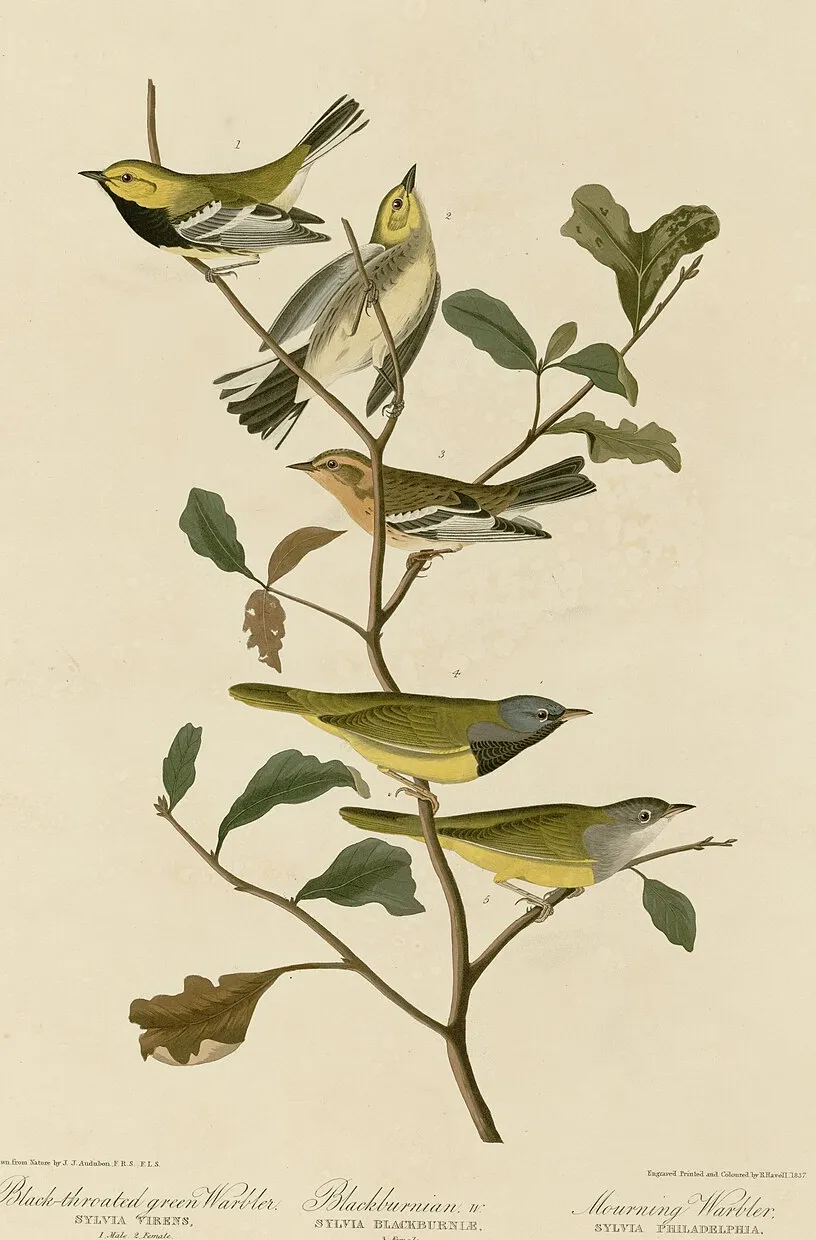
Black-throated Green Warbler
“Considered one of the most widespread breeding warblers in Maine, the Black-throated Green Warbler is an agile upper canopy dweller with a delightfully persistent song.”
Through the year
Columns that mention it, by the month they were published.
Year by year
Columns that mention it each year.
In his words
Ten of the 33 passages, oldest first.
On the last days of April the following birds were seen and heard – Palm Warbler, Yellow-rumped / Myrtle Warbler, Pine Warbler, Black-throated Green Warbler, Blue- gray Gnatcatcher and Ruby-crowned Kinglets.
Common Yellow Throat’s, American Yellow’s, Black-throated Green, American Redstarts and Pine warblers are confirmed Cape nesters.
Across the more interior intact forest sections of Cape Elizabeth, Black-throated green warblers and Ovenbirds make themselves known.
Alas from the depths of Robinson Woods 2, I heard and saw encouraging numbers of Black-throated Green Warblers - Common Yellowthroats were entirely common too.
During the first two weeks of September I saw good numbers of Black-throated Green Warblers and American Redstarts.
At this time last year migrants like the Eastern Towhee and Black-throated Green warbler were already here, and in decent numbers.
Black throated Green Warblers could be heard calling throughout the woods as well.
Across the more interior intact sections of Cape Elizabeth, Black-throated Green Warblers and Ovenbirds are making themselves known as are Veery’s. Of the thrush family, the Veery’s breezy spiraling song is enchanting as it echos across the understory.
Other noteworthy mentionings - Wood warblers seen and heard on June 16 across Cape include many Black throated Greens and American Yellows, more than a few Ovenbirds, and tons of American Redstarts and Common Yellowthroats.
Early July yielded some rather oppressive days to be deep in the woods, alas from the depths of Robinson Woods II & III I heard and saw encouraging numbers of Black-throated Green Warblers.
Show all 33 passages
Adding to the count there were lots and lots of Yellow-rumped (Myrtles) and Black-throated Green Warblers travelling together in the Greenbelt swath of land and small pond area just up from the boat rack area at Great Pond.
Later in the afternoon on this same day I had my first Ovenbird (a very special, chunky, with bold black-and-orange crown striped warbler of the deep forest floor) and I also heard the cheery-buzz of several Black-throated Green Warblers.
Additional mentionables for the last two weeks of the month include - a kaleidoscopic array of wood warblers including Common Yellowthroats, American Yellow, Nashville, Wilsons, Chestnut-sided, Magnolia, American Redstart, Black-throated Green, Bay-breasted, Canada, Blackburnian, Blackpoll and Tennessee.
Across the more interior intact sections of Cape Elizabeth, Black-throated Greens, Ovenbirds and Pine Warblers are still making themselves known as are Veerys.
Our resident canopy dwellers including the Black-throated Green Warbler sings its buzzy ringing “trees, trees I love trees” and from the shadows of our primeval White Pine stands emanates the steady trilling song of the Pine Warbler.
Alas from the depths of Gull Crest there are still singing warblers including - American Redstarts, Black-throated Green, Chestnut-sided and Ovenbirds.
Also, the second day of May brought the cheery zee zee zo zo see buzz of Black-throated Green Warblers to our woodlands.
Stepping into the more interior, intact wooded sections of Cape just before dark, Great-crested Flycatchers, Eastern Wood Peewees (another forest flycatcher), Black-throated Green Warblers, Pine Warblers and Ovenbirds all sing in earnest.
On June 19 my wife, son and I spotted a Willet (stocky shorebird about the size of a crow) from Sawyer Road crossing through the Rachel Carson National Wildlife Refuge and heard two Black-throated Green Warblers along the road down to Crescent Beach.
Also, on July 11 within Robinson Woods I and II the following birds were observed or heard: Belted Kingfisher, Northern Flicker, Great Crested Flycatcher, Common Yellowthroat, Pine and Black-throated Green Warblers were all singing.
Our resident canopy dwellers, including the Black-throated Green Warbler, sings its buzzy ringing “trees, trees I love trees” and from the shadows of a primeval White Pine stand emanates the steady trilling song of the Pine Warbler.
On first day of June within the dark forest interior of Robinson Woods I was treated to a dusk chorus of Veery’s, Hermit Thrushes, a Winter Wren, Black-throated Green Warblers, Ovenbirds, Redstarts and Northern Parulas.
Our summer resident upper canopy dwellers including the Black-throated Green Warbler sings its buzzy ringing “trees, trees I love trees” and from the heights of an old stand of White Pines emanates the steady trilling song of the Pine Warbler.
I recently learned that when foraging amongst other warbler species Yellow-rumped warblers generally let Magnolia, Black-throated Green and Palm Warblers do as they wish, however with Blackburnian and Pine Warblers their behavior is more assertive.
Ovenbirds sounding off across the forest floor, Chestnut-sided, Pine, Myrtle, Black-and-White, American Redstart, Northern Parulas, Black-throated Green and first of season Blackpoll and Bay Breasted Warblers.
Also singing were Black-throated Green Warblers, Redstarts and Northern Parulas.
Considered one of the most widespread breeding warblers in Maine, the Black-throated Green Warbler is an agile upper canopy dweller with a delightfully persistent song.
I could also hear the calls from Black-throated Green Warblers in the surrounding woods and the squeaky wheel turning, wee-see-wee-see-wee-see call notes from Black-and-white Warblers.
That afternoon a walk around Hinkley Park in South Portland with my family yielded a Northern House Wren, Black-and-white Warblers, Black-throated Green Warblers, three Northern Parulas, a Chestnut-sided Warbler and a pair of male American Restarts.
The following day I was treated to a pre dusk chorus of Veerys, Hermit Thrushes, a Winter Wren, Black-throated Green Warblers and Ovenbirds.
Additionally, on September 7 while traveling the back trail of Crescent Beach State Park, a small mixed party of birds appeared to include one each of the following: American Redstart, Black-throated Green Warbler, Cape May Warbler, and Philadelphia Vireo.
Later that day, I welcomed my first Northern House Wren of the season back to the garden and while walking the fringes of the bog below our house, my son and I watched a male Black throated Green Warbler bathing in a shallow, gently moving “warbler stream.”
Lastly, on more than one occasion in late July, while walking through Robinson Woods II and III, I was greeted by the measured songs of the Winter Wren accompanied by Black-throated Green Warblers and Hermit Thrushes.