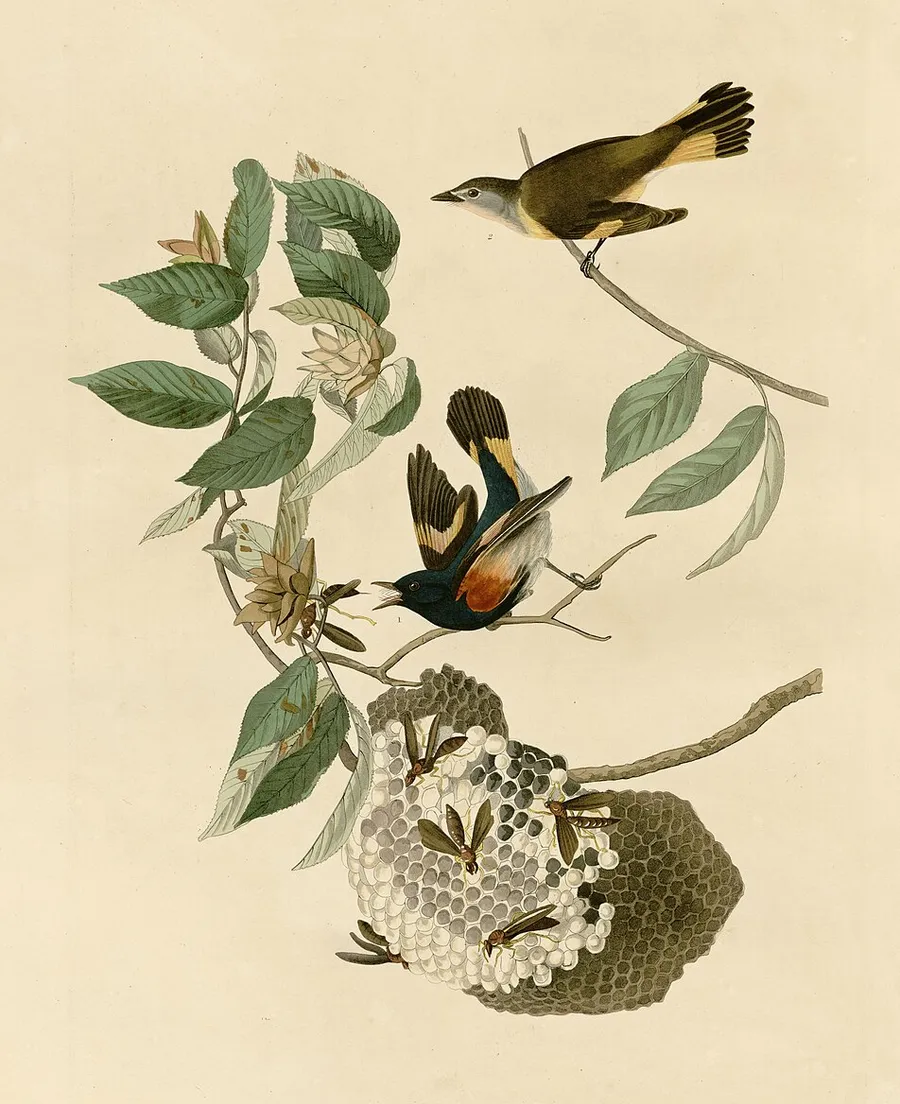
American Redstart
“Common Yellow Throat’s, American Yellow’s, Black-throated Green, American Redstarts and Pine warblers are confirmed Cape nesters.”
Through the year
Columns that mention it, by the month they were published.
Year by year
Columns that mention it each year.
In his words
Ten of the 35 passages, oldest first.
Common Yellow Throat’s, American Yellow’s, Black-throated Green, American Redstarts and Pine warblers are confirmed Cape nesters.
In the late afternoon of May 28 the Gull Crest trails were absolutely teeming with American Yellows, Redstarts, Ovenbirds and Common Yellowthroats.
Redstarts and Common yellowthroats are abundant and well known to the person that chooses to listen.
I have also had good looks at immature American redstarts (warbler) both in the yard and across the Gull Crest trail system.
During the first two weeks of September I saw good numbers of Black-throated Green Warblers and American Redstarts.
Working my way up towards the top of the property, I was pleasantly surprised to find a big congregation of warblers, including my first of season American Redstarts and a Great-crested Flycatcher.
Along Shore Road in nearly every flowering tree there were significant numbers of Magnolia warblers, American Redstarts and Tennessee warblers.
Also, still abundant in our damp deciduous and mixed woods, the American Redstart with its pent-up bit of feathered pizzazz flutters and darts while displaying its black and flame colored plumage.
Other noteworthy mentionings - Wood warblers seen and heard on June 16 across Cape include many Black throated Greens and American Yellows, more than a few Ovenbirds, and tons of American Redstarts and Common Yellowthroats.
This fellowship of the feather yielded some reasonable numbers of warblers including immature and adult American Redstarts and a handful of Northern Parulas.
Show all 35 passages
Additional mentionables for the last two weeks of the month include - a kaleidoscopic array of wood warblers including Common Yellowthroats, American Yellow, Nashville, Wilsons, Chestnut-sided, Magnolia, American Redstart, Black-throated Green, Bay-breasted, Canada, Blackburnian, Blackpoll and Tennessee.
Also, still abundant in our damp deciduous and mixed woods is the American Redstart.
Adding to the chorus at sundown are Common Yellowthroats and Yellow Warblers, American Redstarts, Veery’s, Great-crested Flycatchers, Eastern Wood-Peewees and Red-winged Blackbirds.
Alas from the depths of Gull Crest there are still singing warblers including - American Redstarts, Black-throated Green, Chestnut-sided and Ovenbirds.
Earlier that same day I spotted an American Redstart (warbler) and a Red-eyed Vireo in a crab apple tree on our property.
This fellowship of the feather yielded some reasonable numbers of warblers including on September 13 immature and adult American Redstarts and an ensemble of Northern Parulas gleaning/fluttering in pursuit of small hairless inchworms like the fall canker worm.
Long distance migrants like the American Redstart may still be flitting about ancient Mayan temples in Mexico.
Common Yellowthroats also showed up in huge numbers as did Black-throated blue Warblers, Chestnut-sided Warblers and American Redstarts.
Lastly on June 20 along the fringes of the town dump and Gull Crest, there were American Redstarts, Common Yellowthroats, Yellow Warblers and Chestnut-sided Warblers all vigorously defending their bushy fiefdoms through song.
Observations over the first two weeks of September include, on the 5th within Robinson Woods, six American Redstarts, three Wood Duck youths, a Belted Kingfisher, two Eastern Wood-Peewees, one female Black-throated Blue Warbler and several Cedar Waxwings hawking insects over Pond Cove.
Many American Redstarts and several Pine Warblers also were seen across Gull Crest and Cross Hill.
The chorus here at sundown included Common Yellowthroats and Yellow Warblers, American Redstarts, Great-crested Flycatchers, Eastern Wood-Peewees and Red-winged Blackbirds.
Additionally, along the fringes of the town dump and Gull Crest there were American Redstarts, Common Yellowthroats, Yellow Warblers, and Chestnut-sided Warblers all vigorously defending their bushy fiefdoms through song.
Additionally, on September 10 I recorded seeing a single Yellow-bellied Flycatcher, Swamp Sparrow and American Redstart along the Great Pond Boardwalk and on the same day three Black-and-White Warblers, a single American Woodcock and singing Common Yellowthroat along Gull Crest.
The third wave of songbirds coincides with the arrival of flying insects and caterpillars, this group includes cuckoos, four different flycatcher types, Red-eyed Vireos, American Redstarts and Wilson’s Warblers.
On first day of June within the dark forest interior of Robinson Woods I was treated to a dusk chorus of Veery’s, Hermit Thrushes, a Winter Wren, Black-throated Green Warblers, Ovenbirds, Redstarts and Northern Parulas.
The chorus at sundown includes Common Yellowthroats and Yellow Warblers, American Redstarts, Great-crested Flycatchers, Eastern Wood-Peewees and Red-winged Blackbirds.
Not long after setting out I came across a little party of southbound American Redstarts and Northern Parulas darting and fluttering.
Ovenbirds sounding off across the forest floor, Chestnut-sided, Pine, Myrtle, Black-and-White, American Redstart, Northern Parulas, Black-throated Green and first of season Blackpoll and Bay Breasted Warblers.
Also singing were Black-throated Green Warblers, Redstarts and Northern Parulas.
American Redstarts and Northern Parulas clung to the branches of oaks, ashes and maples, as if dripping from the trees themselves.
Also, in the damper deciduous and mixed woods sections were many American Redstarts.
Additionally, on September 7 while traveling the back trail of Crescent Beach State Park, a small mixed party of birds appeared to include one each of the following: American Redstart, Black-throated Green Warbler, Cape May Warbler, and Philadelphia Vireo.
American Redstarts and Northern Parulas clung to the budding branches of oaks, ashes and maples, as if dripping from the trees themselves.
Lastly, on June 20, along the fringes of the town transfer station, Gull Crest, and CELT lands, Ovenbirds, American Redstarts, Common Yellowthroats, Yellow Warblers, and Chestnut-sided Warblers were all vigorously defending their leafy fiefdoms through song.