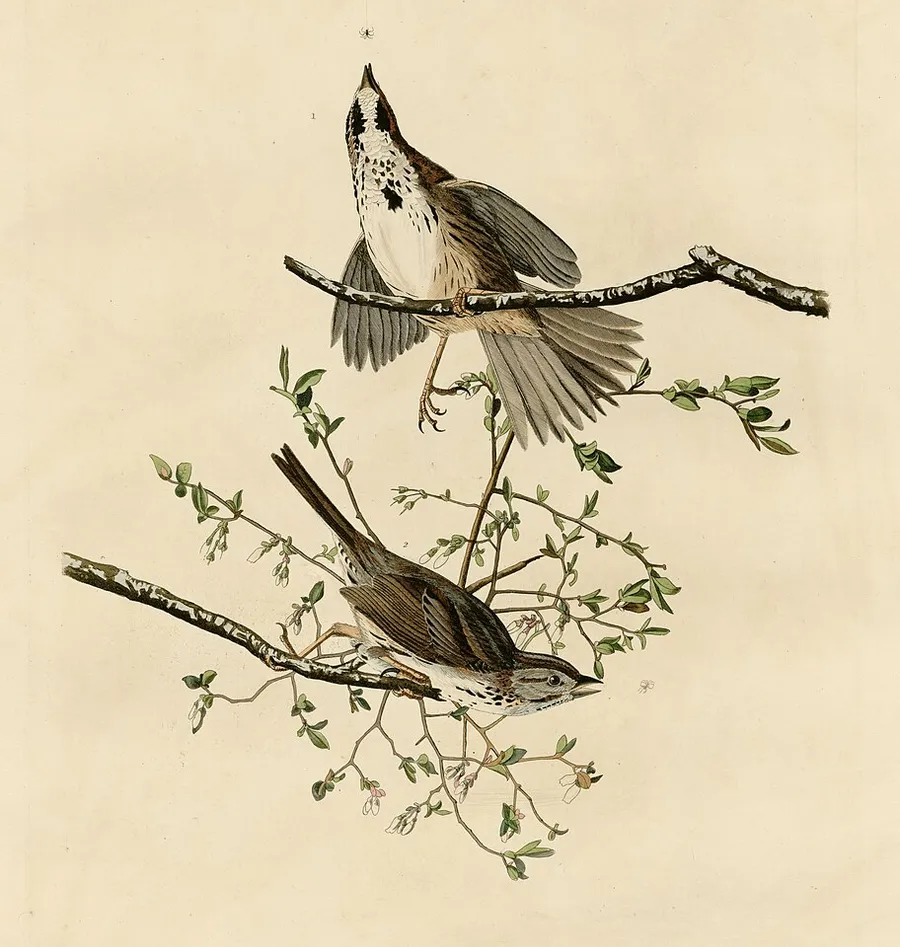
Song Sparrow
“Nagging northerly winds in the third week of March slowed down travel plans for many passerines however the first wave of the deluge included solid numbers of Song Sparrows arriving across Cape Elizabeth.”
Through the year
Columns that mention it, by the month they were published.
Year by year
Columns that mention it each year.
In his words
Ten of the 20 passages, oldest first.
Song Sparrows and good numbers of male Red-winged Blackbirds arrived the last week in February - staking out their territories along the Scarborough Marsh and Gull Crest wetlands, as did Common Grackles - announcing their arrival with croak like whistles and iridescent bluish hoods.
A female Common Eider teaching a gaggle of chicks to dive for crustaceans, several Swamp Sparrow fledglings - Song Sparrow and Chickadee fledglings are out and about as well.
Two song sparrows arrived on the seventeenth and joined the chorus of House finches, Pine finches, Gold finches, Titmice and Cardinals.
Chipping sparrows arrived adding to the mix of Fox, White-throated and Song sparrows.
Song Sparrows were singing too.
Other mentionables include: A female Common Eider teaching a gaggle of chicks to dive for crustaceans, several Swamp Sparrow fledglings - a Red bellied Woodpecker with three young continuing to devour our suet and Song Sparrow, Titmice and Chickadee fledglings are out and about as well.
Many local woodland species have been singing across Cape Elizabeth such as Tufted Titmice, Black-capped Chickadees, House Finches, Song Sparrows, Northern Cardinals and even Carolina Wrens.
Nagging northerly winds in the third week of March slowed down travel plans for many passerines however the first wave of the deluge included solid numbers of Song Sparrows arriving across Cape Elizabeth.
Early spring migrants like the Song Sparrow and Red-winged Blackbird are arriving in greater numbers every day now.
Other mentionables in Two Lights included two Horned Grebes, a male Long-tailed Duck, several Buffleheads, a Northern Gannet, a lone Common Raven and a Song Sparrow.
Show all 20 passages
As for my limited field notes, on March 6 two Song Sparrows arrived in our yard as did a very cautious Common Grackle.
On March 26 in the same vicinity, I noted a male and female Wood duck, a single Golden-crowned Kinglet and many singing Song Sparrows, Brown Creepers and White Breast Nuthatches.
This understated sparrow is not to be confused with its cousin the “Ipswich Savannah Sparrow” which only breeds on Sable Island in Nova Scotia, and is bigger and paler, or the Song Sparrow which looks similar but is also larger.
Fortunately, early spring migrants like the Song Sparrow are appearing in greater numbers every day now.
Larger than a Bluebird or Song Sparrow this rather robust sparrow sports a uniform reddish-chestnut cloak and a clear, full, and flutelike song.
A harbinger of the coming spring, I am thankful for the Song Sparrows that arrive in greater numbers every day now.
Other mentionables in Two Lights included two Horned Grebes, a male Long-tailed Duck, six Buffleheads, a diving Northern Gannet, a Common Raven and two Song Sparrows.
Amongst the dozen or so Song Sparrows, three White-throated Sparrows and pair of Dark-eyed Juncos below our bird feeder on March 23, the Fox Sparrow stood out in the crowd.
Travelling along Fessenden Road yielded hundreds more White-throated Sparrows and several Dark-eyed Juncos and Song Sparrows.
In my backyard a Palm Warbler, a Red breasted Nuthatch, and a Red bellied Woodpecker fed together on suet, their colors catching the setting sun, while White throated, Chipping and Song Sparrows scratched and gave chase below.