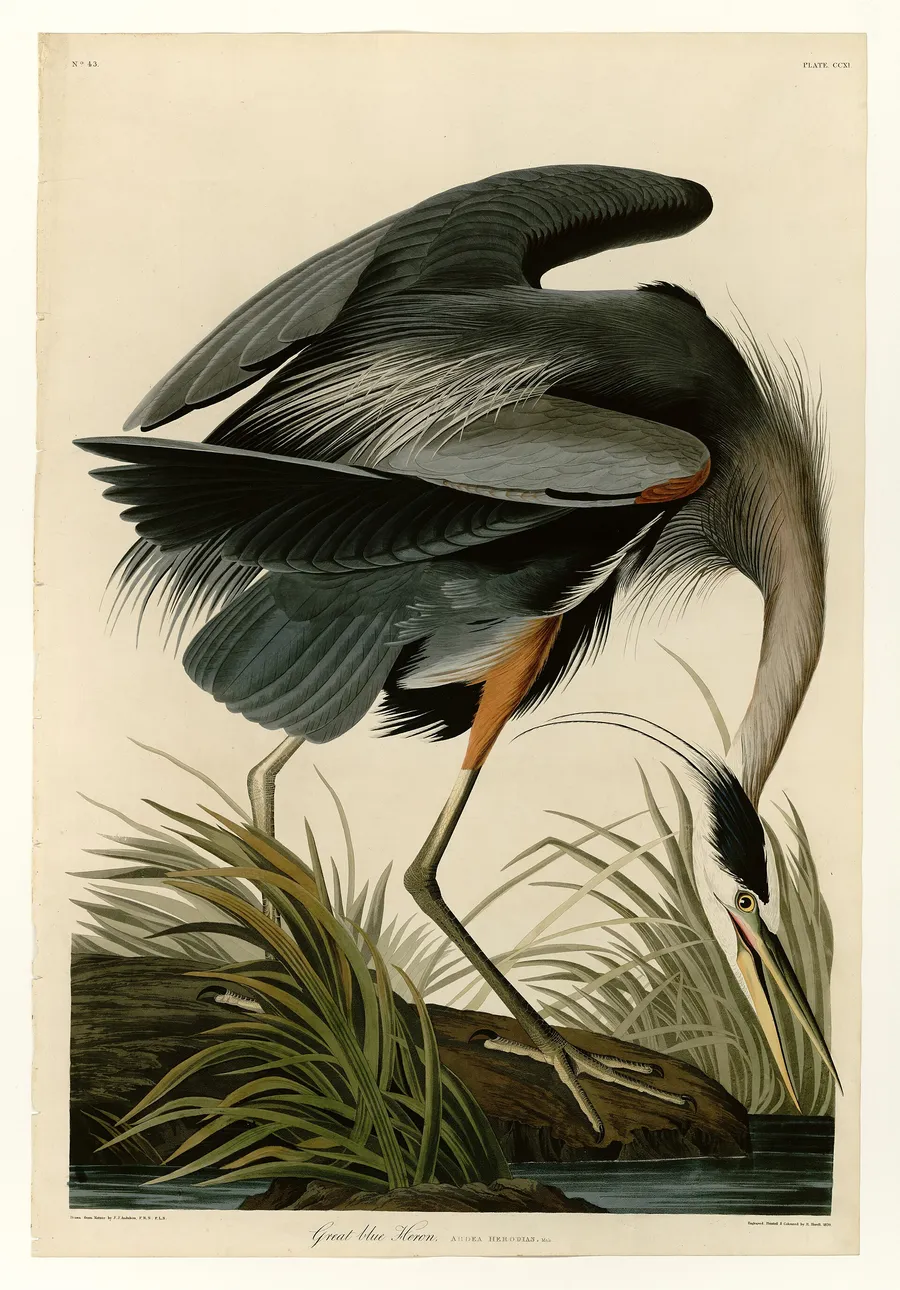
Great Blue Heron
“Great Blue Herons and Great Egrets are also arriving in good numbers, including five flying northbound together at dusk and a scattering of herons and egrets from Scarborough Marsh to the Purpoodock golf course water hazards.”
Through the year
Columns that mention it, by the month they were published.
Year by year
Columns that mention it each year.
In his words
Ten of the 20 passages, oldest first.
Great Blue Herons and Great Egrets are also arriving in good numbers, including five flying northbound together at dusk and a scattering of herons and egrets from Scarborough Marsh to the Purpoodock golf course water hazards.
Miscellaneous sightings include three Glossy Ibis, six Great egrets, and three Great Blue Herons along the stretch of Sawyer Road that runs through the Rachel Carson National Wildlife Refuge.
On September 28 a Great Blue Heron was spied stocking its next victim along the emergent wetlands of Robinson Woods II.
I flushed at least seven woodcocks around “Little Great Pond” and watched the shadowy outline of three first of season (“FOS”) Great Blue herons gracefully flying over the pond before darkness set in.
…two Black-crowned Night Herons and a trio of Glossy Ibis’ flew overhead (probably headed to a nearby island to roost for the night), while at the same moment, a Great Blue Heron stood rather majestically atop the rocky bluffs and a Yellow Warbler made a dash for its secret nighttime nook.
On September 28 a Great Blue Heron was spied stalking its next victim along the emergent wetlands of Robinson Woods II.
Noteworthy mentionings include, on March 28 two Great Blue Herons at sunset migrating so high above our house that they were barely visible even with binoculars and on the 29th, First of Year Eastern Phoebe’s showed up in Robinson woods along the pond.
This particular heron is larger than a Snowy Egret, but a good deal smaller than a Great Blue Heron and it’s coloring is a comingling of lavender, blue-gray and white.
Adding to the backdrop, seven Great Egrets and two Great Blue Herons dotted the estuary while four tiny prancers with golden boots (Snowy Egrets) herded their prey.
Also, on November 24 my son spotted a lingering Great-blue Heron along the uppermost tidal dog-legs of the Spurwink river.
Show all 20 passages
In the second week of October along the Spurwink Marsh I recorded seeing a Belted Kingfisher, a first of season Northern Harrier, a single Lesser Yellowlegs, eight Great Egrets, two Great Blue Herons and one Snowy Egret.
On November 4 around dusk my son and I witnessed a Great-blue Heron circle over our house while uttering a persistent, barking squawk .
On March 24 along Pond Cove my son flushed his first Great Blue Heron of the spring.
Two Great-blue Herons were perched awkwardly in a tall white Pine Tree and a Great Egret flew in to join them for the night.
On November 8 I flushed a lingering American Woodcock in Gull Crest and on November 12 my son and I watched a Great Blue Heron along Sawyer Road hunting in the grass and later spotted sixteen American Coots and three wild Mute Swans on Grondin Pond in Scarborough.
The following afternoon, March 19 within the Robinson Woods II, a Barred Owl called out from its shadowy perch as a Great-blue Heron flew overhead.
And on September 8 along the Spurwink Marsh section of Sawyer Road I noted a single Belted Kingfisher, five Snowy Egrets, four Great Egrets and one Great Blue Heron.
Shortly thereafter an eerie guttural squawk pierced the stillness and my imagination went into overdrive—spinning possibilities from logical to the most outlandish (Great blue heron).
During the cold months this species becomes an opportunistic hunter, feeding heavily on sea ducks, geese, grebes, gulls and even lingering Great Blue Herons.
On April 22, while admiring the steady trill of Pine Warblers in Robinson Woods III, Hermit Thrushes slipped through the underbrush and a northbound Great Blue Heron bellowed somewhere overhead.