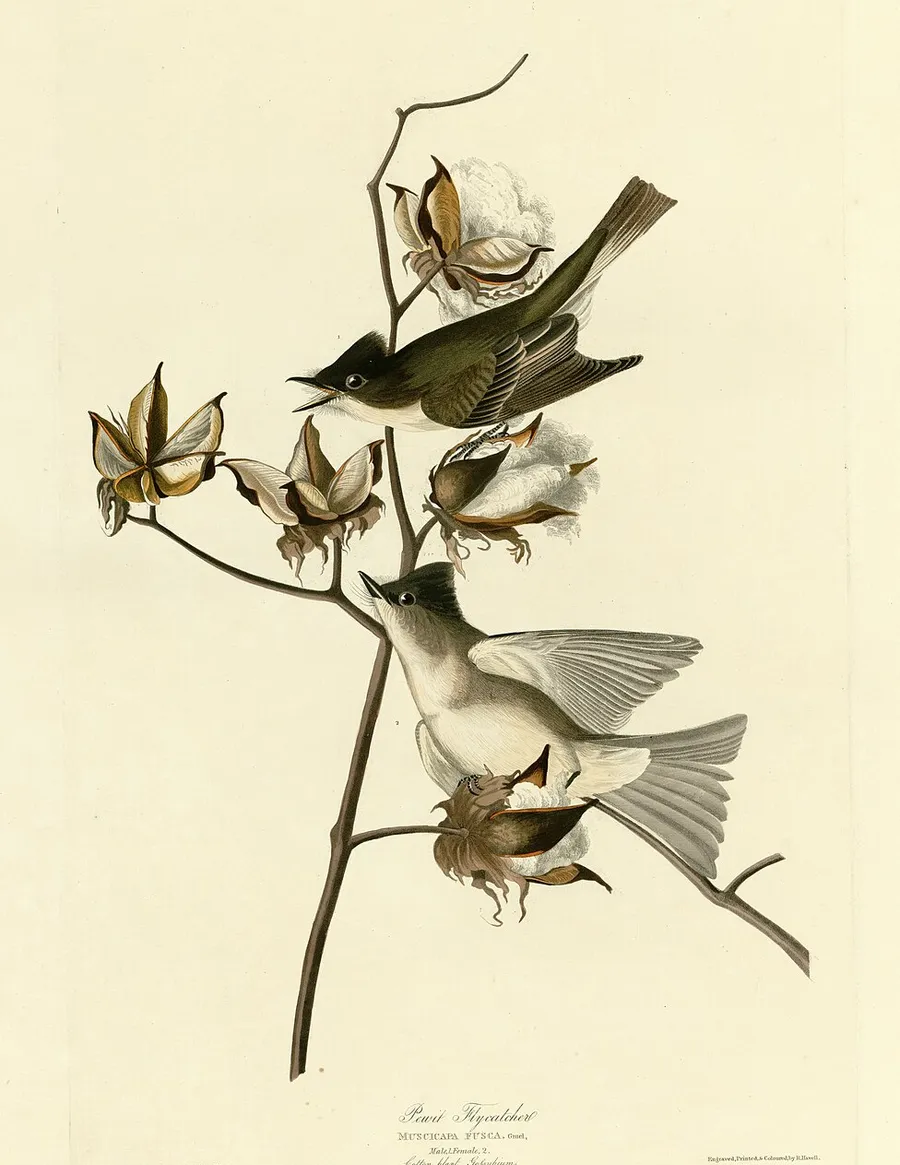
Eastern Phoebe
“Noteworthy mentionings include, on March 28 two Great Blue Herons at sunset migrating so high above our house that they were barely visible even with binoculars and on the 29th, First of Year Eastern Phoebe’s showed up in Robinson woods along the pond.”
Through the year
Columns that mention it, by the month they were published.
Year by year
Columns that mention it each year.
In his words
Ten of the 24 passages, oldest first.
Other notables: an Eastern Phoebe (FOS) on April 2nd along the Gull Crest Trail.
An Eastern Phoebe has been waking me up every morning, starting around dawn.
Two types of flycatchers, eastern phoebe and eastern kingbird were also seen in this area on September 2.
Eastern phoebes have showed up in great numbers as well.
Additionally, we have already had an Eastern Phoebe build a nest in a canoe beside our house.
Other flycatchers seen include Eastern Phoebe, Great-crested Flycatcher, Least Flycatcher and Eastern Wood Pewee.
Also, around June 23 the Eastern Phoebe’s brood above our front door left the nest.
As of July 7, an Eastern Phoebe has been singing outside our window every morning starting around dawn.
Additionally, I had a Common Raven and an Eastern Phoebe (flycatcher) calling along Shore Road on Oct. 5.
Noteworthy mentionings include, on March 28 two Great Blue Herons at sunset migrating so high above our house that they were barely visible even with binoculars and on the 29th, First of Year Eastern Phoebe’s showed up in Robinson woods along the pond.
Show all 24 passages
Eastern Phoebes are increasing in abundance as well, with a total of six flycatchers spotted at Pond Cove working the wrack line on April 12.
Through hearing its song, we were able to rule out other flycatchers such as the Eastern Phoebe, Least Flycatcher and Eastern Wood-Pewee.
Lastly, on October 13 from the Spurwink trail I spied two Great Egrets pursuing prey within the tidal dog legs, a single Eastern Phoebe (flycatcher) and a Palm Warbler meandering between the trail and thickets.
Visibly smaller than a Robin but bigger than an Eastern Phoebe, the Eastern Kingbird prefers to breed at the intersection of overgrown meadows, forest edges and ponds.
Migratory woodpeckers such as the Northern Flicker and Yellow-bellied Sapsucker numbers peak in April as do Brown Creepers, Eastern Phoebes, Winter Wrens, Brown Thrashers, White-throated Sparrows, Swamp Sparrows, and fleeting pass through migrants like Fox Sparrows and “Ipswich” Savanah Sparrows.
The Eastern Phoebes nesting in the eaves above our front door have recently fledged and two separate pairs of Bluebirds nesting in woodpecker cavities along the side of our house both have noisy broods.
Additionally on 9/24 along the Gull Crest trails I came across five Eastern Phoebes, several Black-and-White Warblers and a single male Blue-throated Black Warbler.
On October 8 I counted six Gray Catbirds calling and scolding along Shore Road along with several Eastern Phoebes in fresh fall plumage.
On March 31 along Pond Cove, I came across my first of the year Eastern Phoebe working the wrack line and a Merlin headed north.
The Eastern Phoebes that nest in the eaves above our front door every year did not make a go at it this spring.
Also, on October 13 in the yard I noted a sallying Eastern Phoebe and a Yellow-bellied Sapsucker hunting for insects in an old crab apple tree.
On this same outing I noted five Eastern Phoebes, three gloriously yellow male Pine Warblers and a single male Palm Warbler along the fringes of the great meadow in Robinson Woods.
Slightly smaller than a Robin but larger than an Eastern Phoebe, the Eastern Kingbird favors breeding sites where overgrown meadows meet forest edges and ponds.
Another recent observation has centered on our early morning songsters: Catbirds, Robins, Eastern Phoebes, Cardinals, and Chipping Sparrows.