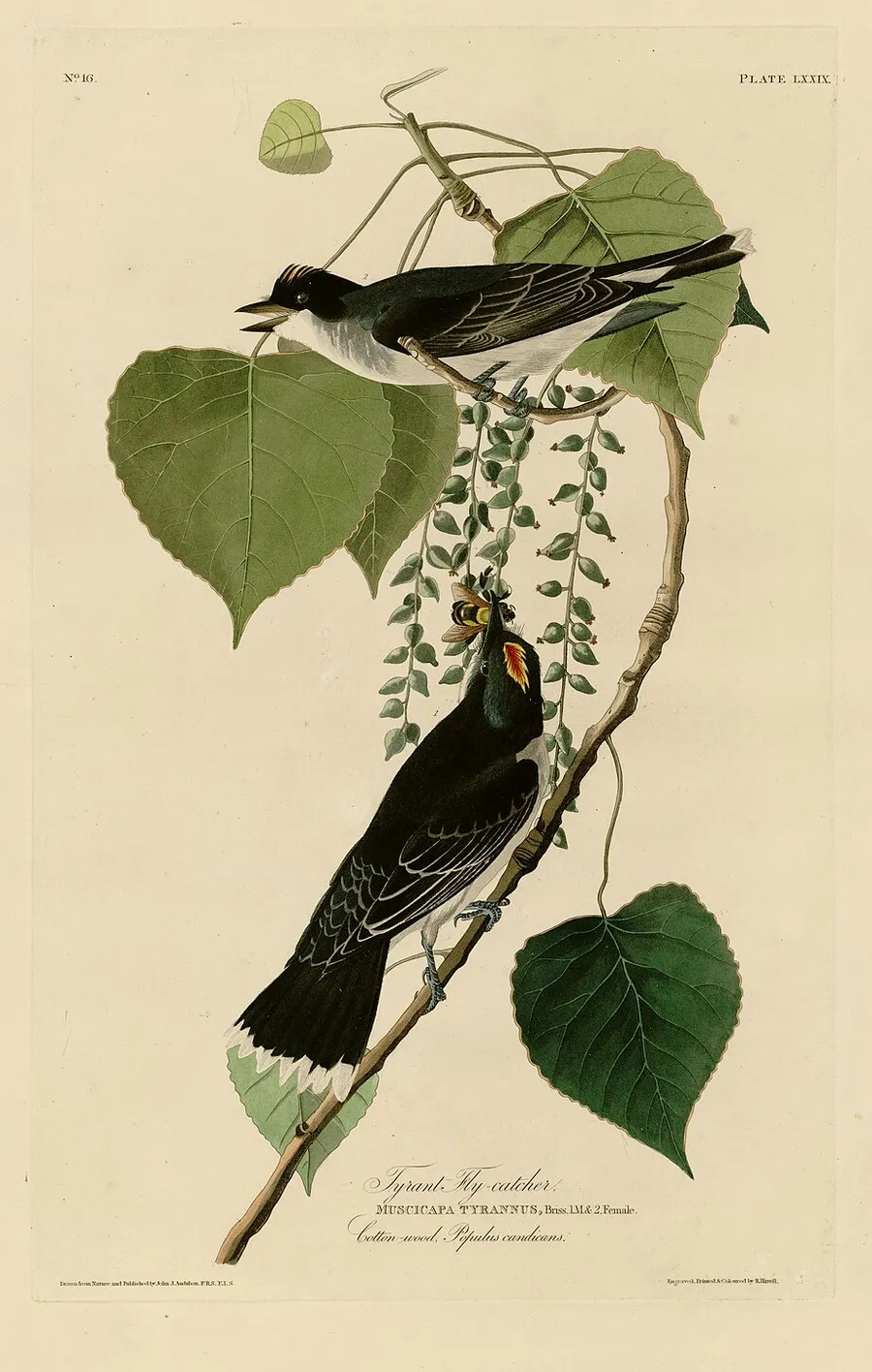
Eastern Kingbird
“Still conspicuously calling in late July were Hermit Thrushes, Eastern Wood-pewees, Great-crested Flycatchers, Eastern Kingbirds, Red-eyed Vireos, Gray Catbirds and Robins.”
Through the year
Columns that mention it, by the month they were published.
Year by year
Columns that mention it each year.
In his words
All 9 passages, oldest first.
Two types of flycatchers, eastern phoebe and eastern kingbird were also seen in this area on September 2.
On May 16 Pond Cove saw the arrival of the largest tyrant flycatcher in North America, the fearless Eastern Kingbird.
Visibly smaller than a Robin but bigger than an Eastern Phoebe, the Eastern Kingbird prefers to breed at the intersection of overgrown meadows, forest edges and ponds.
Noticeable waves of northbound migrants will arrive towards the end of April including Gray Catbirds, House Wrens, Eastern Kingbirds along with Least and Great-Crested Flycatchers.
On the afternoon of May 6 along the Winnick Woods trails my son and I heard a strange series of high-pitched, metallic zapping sounds coming from a bird perched atop a tree and determined it to be an Eastern Kingbird.
Still conspicuously calling in late July were Hermit Thrushes, Eastern Wood-pewees, Great-crested Flycatchers, Eastern Kingbirds, Red-eyed Vireos, Gray Catbirds and Robins.
The surrounding pond shrubbery at sunset was teaming with Common Yellowthroats and Yellow Warblers and also included Chestnut-sided Warblers, Gray Catbirds and Eastern Kingbirds.
On July 9 within the Rachael Carson National Wildlife Refuge along Sawyer Road I observed six Least Sandpipers, three Greater Yellowlegs and a Willet noisily driving an Eastern Kingbird from its perch atop a metal pole.
Slightly smaller than a Robin but larger than an Eastern Phoebe, the Eastern Kingbird favors breeding sites where overgrown meadows meet forest edges and ponds.