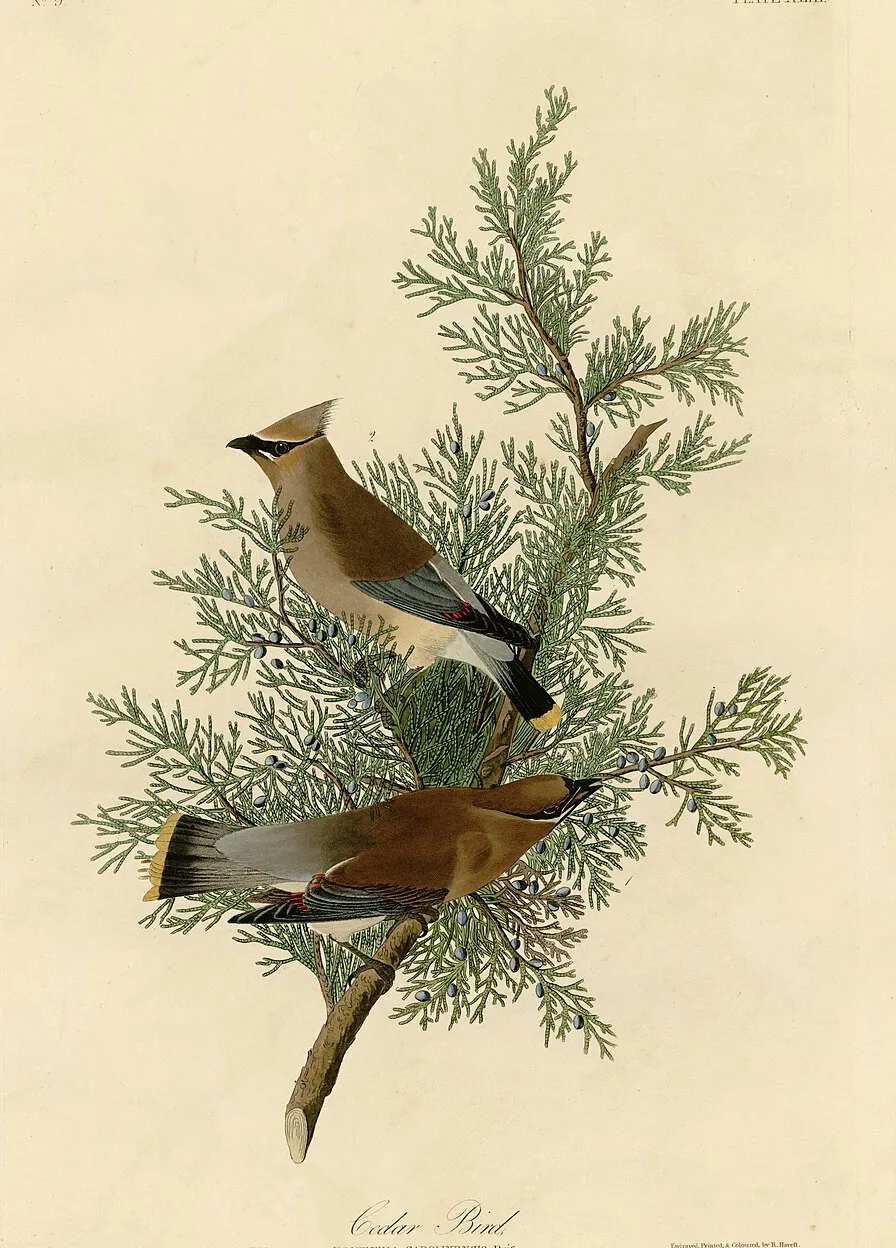
Cedar Waxwing
“Other mentionables across town include -many hundreds of Cedar Waxwings could be found throughout our woodlands, perhaps mother nature’s way of helping protect our treasured oak trees.”
Through the year
Columns that mention it, by the month they were published.
Year by year
Columns that mention it each year.
In his words
Ten of the 24 passages, oldest first.
I had neglected to mention this in my last rambling - starting around May 28 hundreds of Cedar Waxwings could be found throughout our woodlands - mother nature’s way of helping protect our treasured Oak and Maple tree.
A big brother of the more familiar and widespread Cedar waxwing, this was the first time I have ever seen Bohemians in Cape.
Taking a closer peek revealed four Cedar waxwings fluttering and plucking at an ornamental berry bush.
Other mentionables – I had neglected to mention this in my previous report, starting in late May, hundreds of Cedar Waxwings could be found throughout our woodlands, mother nature’s way of helping protect our treasured oak trees.
American Goldfinches have been plucking nesting material from the ball of alpaca fiber I put outside in a crab apple tree and my mother-in-law on Two Lights Road reports that Cedar Waxwings made quick work of the nesting ball she had out as well.
Later that same sunny, cold afternoon a flock of 25 or more Cedar Waxwings appeared in an Oak tree on our property.
On April 17 the first Osprey of the year flew over the house as did a boisterous flock of eight Cedar Waxwings.
Other mentionables across town include -many hundreds of Cedar Waxwings could be found throughout our woodlands, perhaps mother nature’s way of helping protect our treasured oak trees.
I also saw and heard numerous Cedar Waxwings with young emerging from the thickets along the rocky shoreline and a young family of Black-capped Chickadees.
On this same day I noted a small flock of Cedar Waxwings, a Swainson’s Thrush, a Savannah Sparrow, and a single Field Sparrow in our yard.
Show all 24 passages
A flock of twenty or more Common Terns in Pond Cove on May 20, Cedar Waxwings appearing locally throughout Cape starting on May 21 and a Indigo Bunting and Prothonotary Warbler in Hinckley Park on May 22.
Also, hundreds of Cedar Waxwings could be found throughout our woodlands in early June, perhaps Mother Nature’s way of helping protect our treasured oak trees.
Observations over the first two weeks of September include, on the 5th within Robinson Woods, six American Redstarts, three Wood Duck youths, a Belted Kingfisher, two Eastern Wood-Peewees, one female Black-throated Blue Warbler and several Cedar Waxwings hawking insects over Pond Cove.
Cedar Waxwings numbers are also beginning to build across town.
By mid-to-late June the lisping cries from flocks of Cedar Waxwings have begun to wane across the upper canopies of our woodlands and summer resident songbirds are getting down to business.
Additional mentionings from across town include a male Belted Kingfisher and many Cedar Waxwings sallying and gleaning over the Pond Cove brook corridor in Robinson Woods III, Seven Piping Plovers along Kettle Cove Beach on July 29 and an Artic Tern…
Lastly, on September 11 in Robinson Woods III, I noted a total of twelve Red-breasted Nuthatches, six Cedar Waxwings, a Belted Kingfisher fishing and four young Wood Ducks, their bright red eyes and red and white bills illuminated by last rays of the setting sun.
I was also treated to the songs of Veery’s, Hermit Thrushes, Great-crested Flycatchers, Cedar Waxwings and a single and Wood Thrush and Least Flycatcher.
On January 19 a flock of at least thirty Cedar Waxwings made a brief stopover in an old Red Oak Tree behind our house.
By mid-to-late June the lisping cries from flocks of Cedar Waxwings have begun to wane across the upper canopies of our woodlands and our summer resident songbirds are getting down to business.
A flock of seven Cedar Waxwings passed overhead.
Taking a closer peek revealed a small flock of Cedar Waxwings fluttering and plucking at an ornamental berry bush.
Other mentionables across town include the following: many hundreds of Cedar Waxwings could be found throughout our woodlands, perhaps mother nature’s way of helping protect our treasured trees.
Cedar Waxwings, by contrast, are sleeker, with warm brown chests fading into pale yellow bellies.