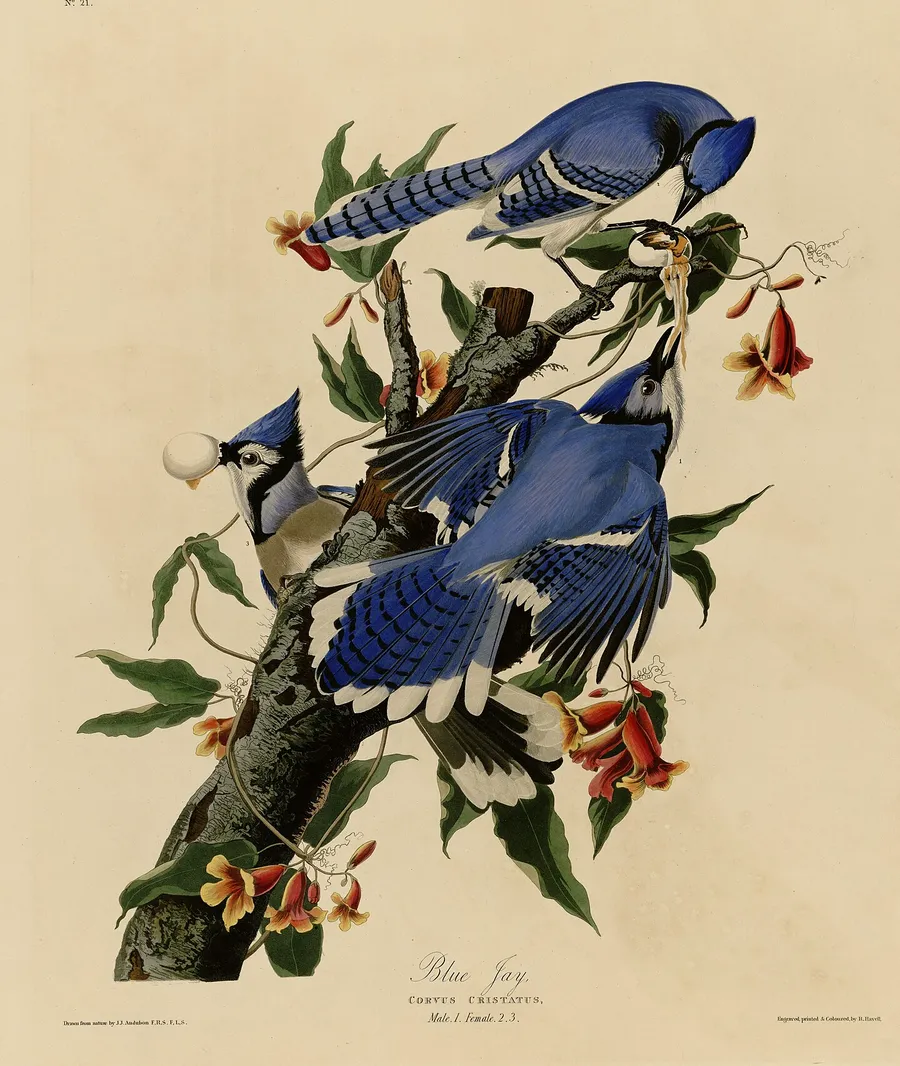
Blue Jay
“A family of blue jays with a cast of six molting young continuing to decimate my suet supplies.”
Through the year
Columns that mention it, by the month they were published.
Year by year
Columns that mention it each year.
In his words
Ten of the 15 passages, oldest first.
A family of blue jays with a cast of six molting young continuing to decimate my suet supplies.
When I first caught wind of the nest one of the parents darted out and landed on a nearby branch, arched it head slightly back and broke into a lovely Blue Jay call imitation.
Both Blue-jays and Grosbeaks have declined 25% and Baltimore Orioles by a whopping 31%.
Other backyard patch notables include a sizable uptick in Gray Catbirds and Blue Jay numbers.
Additional mentionings from the yard and across town include a leucistic Chipping Sparrow and a band of fifteen boisterous Blue Jay youngsters that forced me to temporarily cease my backyard feeding operations.
Numerous molting young Blue Jays continue to decimate my suet supplies.
The report now also includes three non-finch passerines whose populations intensify periodically as well - Blue Jays, Bohemian Waxwings and Red-breasted Nuthatches.
Sitting upright like a bird of prey, the sharp-eyed butcher descends, attacking birds of the same size such as Robins and Blue Jays and often “preserving” its catch by suspending victims on a nail or between the fork of two branches.
On the morning of July 3 five fledgling Baltimore Orioles and a Red-breasted Nuthatch managed to find room on our suet cage and were surrounded by an entourage of crying young - in particular, Red-bellied and Hairy Woodpeckers, Blue Jays and Tufted Titmice.
The highest concentrations of reported illnesses are with Robins, Blue Jays and Common Grackles.
Show all 15 passages
While wandering along the fringes of Robinson Woods III and a neighbor’s property a boisterous band of Blue Jays alerted me to a stand of old White Pine trees and where, fifty or so feet up was a hunkered down Great Horned Owl.
One of my favorite things about Blue-gray Gnatcatchers is their ability to produce a soft, pleasing warbling ditty, often including mimicked bits from repertoires of other birds including wood warblers, vireos, towhees and Blue Jays.
I had forgotten how small the males are, not much bigger than a Blue Jay.
Slightly smaller than a Blue Jay, this normally secretive bird is one of North America’s most accomplished songsters, capable of singing over 1,100 distinct song types.
The females, in particular, seem every bit as bold as the males—perhaps even more so—when challenged by Blue Jays or other male grosbeaks vying for a perch.