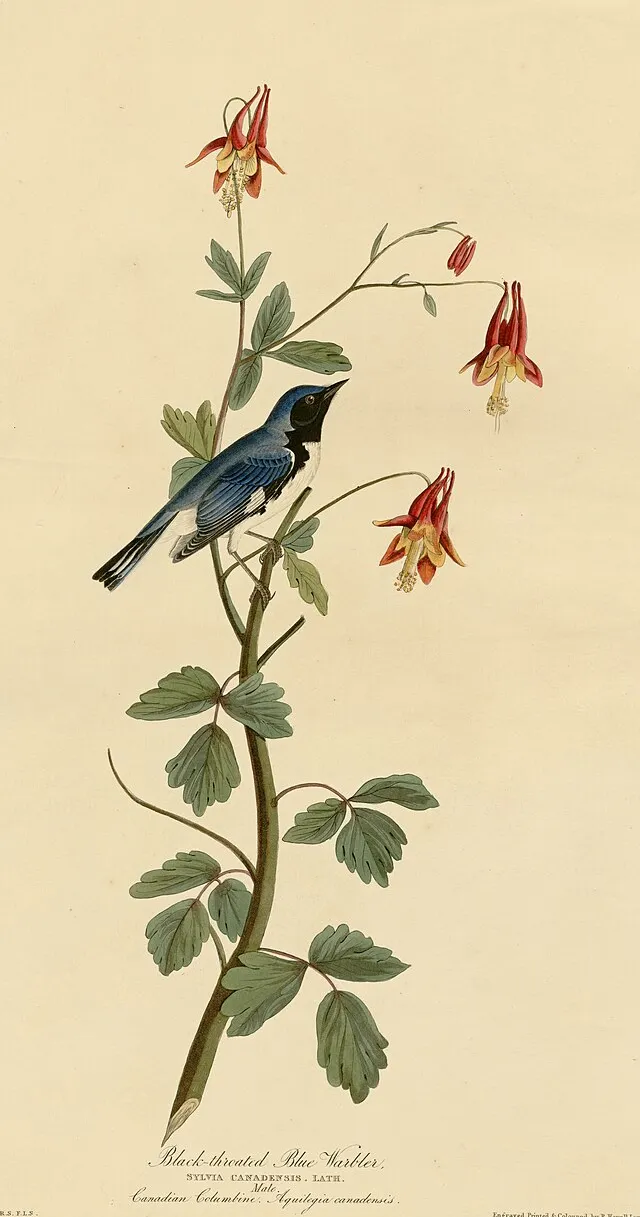
Black-throated Blue Warbler
“To our delight, on Oct. 7 a male Black-throated Blue Warbler showed up on the backyard suet.”
Through the year
Columns that mention it, by the month they were published.
Year by year
Columns that mention it each year.
In his words
Ten of the 19 passages, oldest first.
With a bit of luck, I finally got a Black-throated Blue Warbler in what is to be, Robinson Woods III.
To our delight, on Oct. 7 a male Black-throated Blue Warbler showed up on the backyard suet.
Later that day a single male Black-throated Blue Warbler passed through, making a brief pitstop in a crab apple tree.
Of special note, this spring has brought more Black-throated Blue Warblers to Cape Elizabeth than the previous four seasons.
Lastly, and just by chance, on the morning of October 24 I stepped out the back door of our garage to find a late travelling male Black-throated Blue warbler in a Lilac bush ‘spiriting’ itself from one perch to another.
Finally, now is a particularly good time of year to think about window strikes and how we all can prevent the death of one spring migrant such as a Black-throated Blue Warbler.
Common Yellowthroats also showed up in huge numbers as did Black-throated blue Warblers, Chestnut-sided Warblers and American Redstarts.
Observations over the first two weeks of September include, on the 5th within Robinson Woods, six American Redstarts, three Wood Duck youths, a Belted Kingfisher, two Eastern Wood-Peewees, one female Black-throated Blue Warbler and several Cedar Waxwings hawking insects over Pond Cove.
Lastly, on the morning of September 28 I looked out my bedroom window to see a stunning male Black-throated Blue Warbler in a tall Lilac bush.
On one particular outing I spied six different types of warblers, including a single Cape May Warbler and two Blackburnian Warblers high up in an old White Birch and six male and two female Black-throated Blue Warblers foraging within a lush fern grove.
Show all 19 passages
I remember spending many hours bird proofing windows in our living room (closest to the feeders) along with my son’s bedroom and feeling such a sense of relief only to hear the dreaded thud at the front door and find a fallen male Black-throated Blue Warbler.
The Black-throated Blue Warblers colors are so unlike any other warbler that the male may be identified after little more than a glance.
The second wave is largely made up of Neotropical travelers, bright-colorful migrants journeying from the tropics like the Blackburnian, Black throated Blue, Magnolia and Yellow Warbler.
Additionally, on October 8 a southbound male Wilson’s Warbler and a female Black-throated Blue Warbler passed through my yard.
Ten different types of Wood Warblers heard and seen including a Cape May Warbler with its tiger striped breast, bright yellow belly and orange-chestnut ear patches aglow and a plucky female Black-throated Blue in the tangles below.
I counted twenty-one different species with Pine Warblers, Common Yellowthroats, Ovenbirds, Black-throated Blue Warblers, and Yellow Warblers appearing in abundance.
In other birding news, a hybrid Black-throated Blue Warbler and Yellow-rumped Warbler was recently discovered on Hilton Head in South Carolina.
Additionally, on October 8, a southbound male Wilson’s Warbler and a female Black-throated Blue Warbler passed through my yard.
I recorded twenty species so far this spring, with Pine Warblers, Common Yellowthroats, Ovenbirds, Black-throated Blue Warblers and Yellow Warblers appearing in abundance.