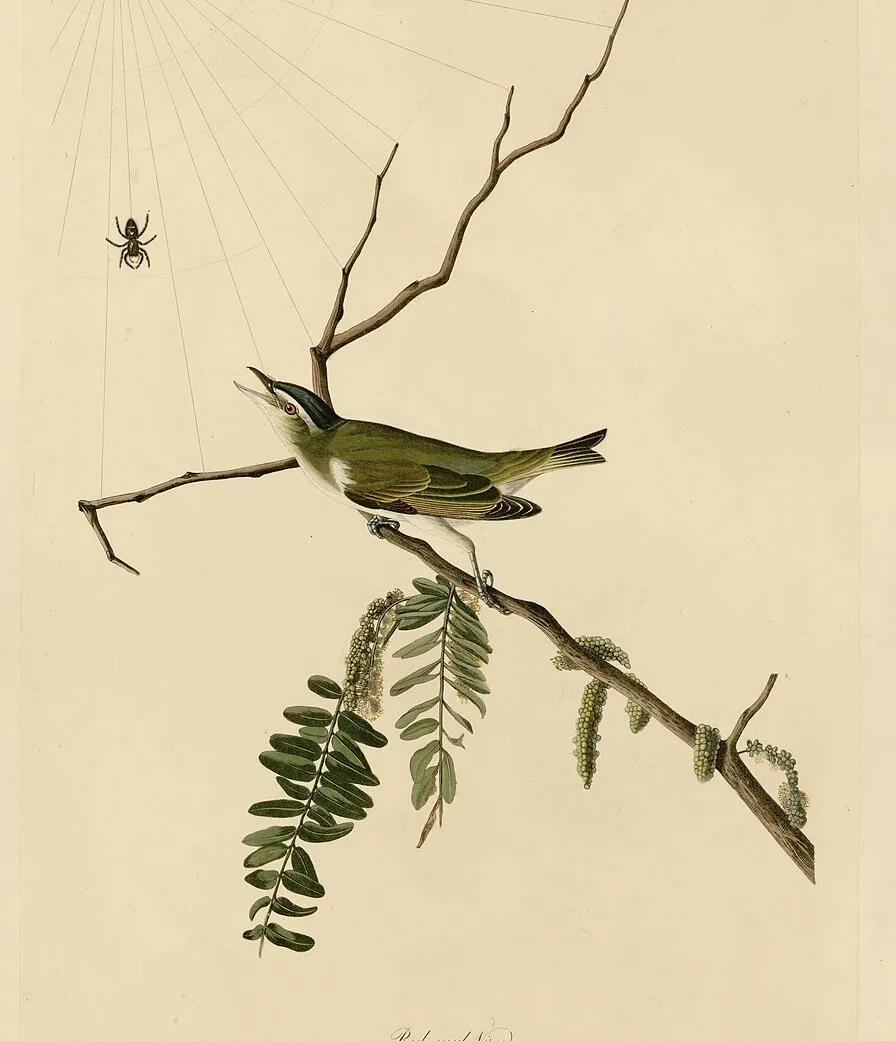
Red-eyed Vireo
“In contrast to the more flowy song of the Warbling Vireo is the abrupt, jerky and at times taunting “look at me, here I am” notes of the Red-eyed Vireo.”
Through the year
Columns that mention it, by the month they were published.
Year by year
Columns that mention it each year.
In his words
Ten of the 18 passages, oldest first.
There was an early female Scarlet Tanager first seen on April 18 (Pond Cove tangles and coastline) along with an unexpected Red-eyed Vireo, and good numbers of Pine Warblers.
Also, Red-eyed Vireos and Red-breasted Nuthatches visited our backyard patch on multiple occasions.
On the 21 I had my first of the year Red-eyed Vireo.
The difficulty with identifying Philadelphia Vireos is that they look similar to the Red-eyed Vireo and their song is very similar to that of the Warbling vireo.
On the last day of September, I arrived home to find a Yellow-bellied sapsucker and a Red eyed Vireo in a Crab apple tree.
Earlier that same day I spotted an American Redstart (warbler) and a Red-eyed Vireo in a crab apple tree on our property.
On June 3, three Red-eyed Vireos were located along Shore Road.
On the morning of September 11 following the big night I found three Northern Parulas, five American Redstarts and twelve Red-eyed Vireos along Shore Road and a single Great-crested Flycatcher along the field borders of Runaway Farm.
In contrast to the more flowy song of the Warbling Vireo is the abrupt, jerky and at times taunting “look at me, here I am” notes of the Red-eyed Vireo.
Additionally, on July 4 a Red-breasted Nuthatch and Northern Flicker were dining together on suet in our yard while a Red-eyed Vireo sang high above in a White Oak Tree.
Show all 18 passages
Still conspicuously calling in late July were Hermit Thrushes, Eastern Wood-pewees, Great-crested Flycatchers, Eastern Kingbirds, Red-eyed Vireos, Gray Catbirds and Robins.
On the southwest side of the island’s woods I came upon four Red-breasted Nuthatches and a Red-eyed Vireo travelling together.
Far less widespread and abundant in Maine, the Philadelphia Vireo can usually be distinguished from the Red-eyed Vireo by their yellow washed underparts and distinct line above the eye that typically contrasts with their darkish gray helmet.
The third wave of songbirds coincides with the arrival of flying insects and caterpillars, this group includes cuckoos, four different flycatcher types, Red-eyed Vireos, American Redstarts and Wilson’s Warblers.
In contrast to the more flowy song of the Warbling Vireo is the abrupt, jerky and at times taunting “look at me, here I am” notes of the Red-eyed Vireo.
Far less widespread and less abundant in Maine, the Philadelphia Vireo can usually be distinguished from the Red-eyed Vireo by their yellow washed underparts and distinct line above the eye that typically contrasts with their darkish gray helmet.
On May 21 within Winnick Woods’ Greenbelt Trail, I noted six Red-eyed Vireos, a Blackburnian Warbler and a clamorous Broad-winged Hawk.
Far less widespread and less abundant in Maine, the Philadelphia Vireo can usually be distinguished from the Red eyed Vireo by its yellow washed underparts and the distinct line above the eye that contrasts with its darker gray “helmet.”