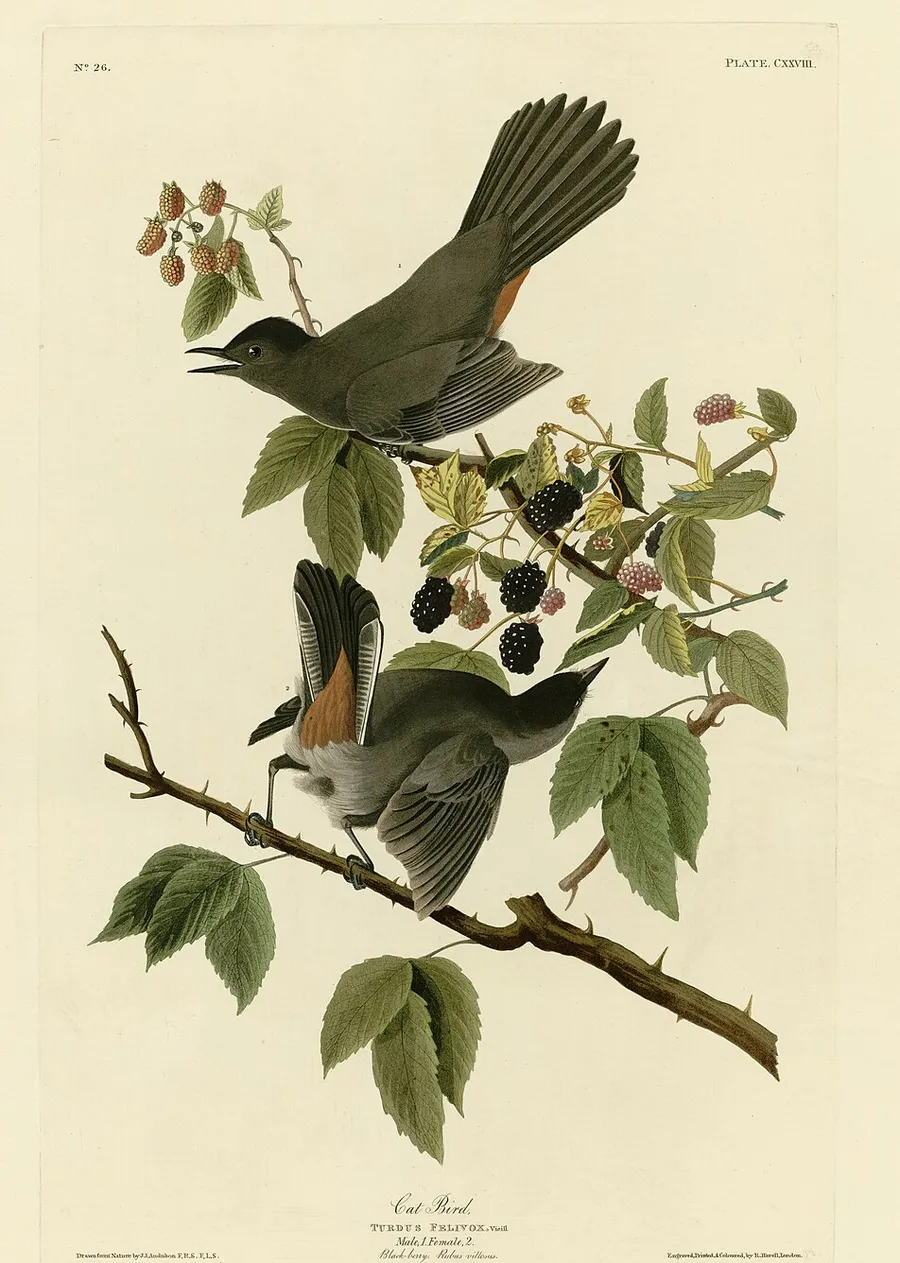
Gray Catbird
“Other Cape breeding mimic-thrush relatives include the Gray Catbird and the Northern Mockingbird.”
Through the year
Columns that mention it, by the month they were published.
Year by year
Columns that mention it each year.
In his words
Ten of the 23 passages, oldest first.
Overwintering Gray Catbirds were spied in Delano Park, Pond Cove, Kettle Cove and Prout’s Neck.
The excitement continued the following day with the first of season Gray Catbirds arriving across cape.
Other Cape breeding mimic-thrush relatives include the Gray Catbird and the Northern Mockingbird.
The following morning our yard saw its first Gray Catbirds and a Ruby-throated Hummingbird.
Other backyard patch notables include a sizable uptick in Gray Catbirds and Blue Jay numbers.
Other birds spotted while in Two Lights include Common Terns, Common Eiders, Ring-billed and Great-black backed Gulls, a Least Sandpiper fly through, a single Osprey and several Gray Catbirds.
Late April brought Brown Thrashers, Eastern Towhees, House Wrens, Gray Catbirds and Rose-breasted Grosbeaks to backyards and bushy margins of abandoned hayfields and forest edges.
Although much of the action in my backyard has slowed down, whenever there is anything going on the House Wren and Grey Catbird, ever consumed with curiosity, are always first on the scene.
Noticeable waves of northbound migrants will arrive towards the end of April including Gray Catbirds, House Wrens, Eastern Kingbirds along with Least and Great-Crested Flycatchers.
Chipping Sparrows arrived a full week later this year and my first Gray Catbird of the season showed up in our yard on the exact same day, April 29, as last spring.
Show all 23 passages
While a female catbird is confined to the nest by the duties of incubation, the male, seemingly in an ecstasy of delight, pours his soul into song both by day and night.
Still conspicuously calling in late July were Hermit Thrushes, Eastern Wood-pewees, Great-crested Flycatchers, Eastern Kingbirds, Red-eyed Vireos, Gray Catbirds and Robins.
The surrounding pond shrubbery at sunset was teaming with Common Yellowthroats and Yellow Warblers and also included Chestnut-sided Warblers, Gray Catbirds and Eastern Kingbirds.
On 9/18 I came across three Blue-headed Vireos along the northern entrance to Runaway Farm and on 9/20 in my backyard I noted eight, first of season White-throated Sparrows, three lingering Gray Catbirds and from my bedroom window, two Red-eye Vireos and one Philadelphia Vireo.
On October 8 I counted six Gray Catbirds calling and scolding along Shore Road along with several Eastern Phoebes in fresh fall plumage.
By the first day in May last year Gray Catbirds had already arrived as had Blue-headed Vireos, Blue Gray Gnatcatchers, Rose-breasted Grosbeaks, Indigo Buntings and Barn Swallows.
Lastly, on August 6 a male Baltimore Oriole, two Grey Catbirds and two Red-breasted Nuthatches dined together on suet in my backyard while the chattering silhouettes of Chimney Swifts crisscrossed the open sky.
While a female catbird is confined to the nest by the duties of incubation, the male, delighted as can be, pours his soul into song both by day and night.
Additionally, on September 16 I came across three cheery Blue-headed Vireos along the northern entrance to Runaway Farm and on September 20 in my backyard I noted a twenty-seven American Goldfinches, a continuing Ruby-throated Hummingbird and separately two Gray Catbirds, two Red-eye Vireos and a Philadelphia Vireo.
Catbird in size, this large ground dwelling sparrow is striking in appearance, with a white belly vest, cinnamon colored chest and flanks, jet black head/neck and white tail feather corners.
The following morning our backyard was carpeted with White-throated Sparrows along with an array of first of the year birds including a Northern Parula, two Gray Catbirds and a female Eastern Towhee.
Lastly, on the warm late afternoon of August 11, several noisy Common Grackles along with a male Baltimore Oriole, two Gray Catbirds and a Red-breasted Nuthatch gathered at the suet feeder in my backyard.
On one occasion, a female Baltimore Oriole and a Red-bellied Woodpecker dined side by side while a Gray Catbird and a Red-breasted Nuthatch waited, with surprising patience, for their turns.