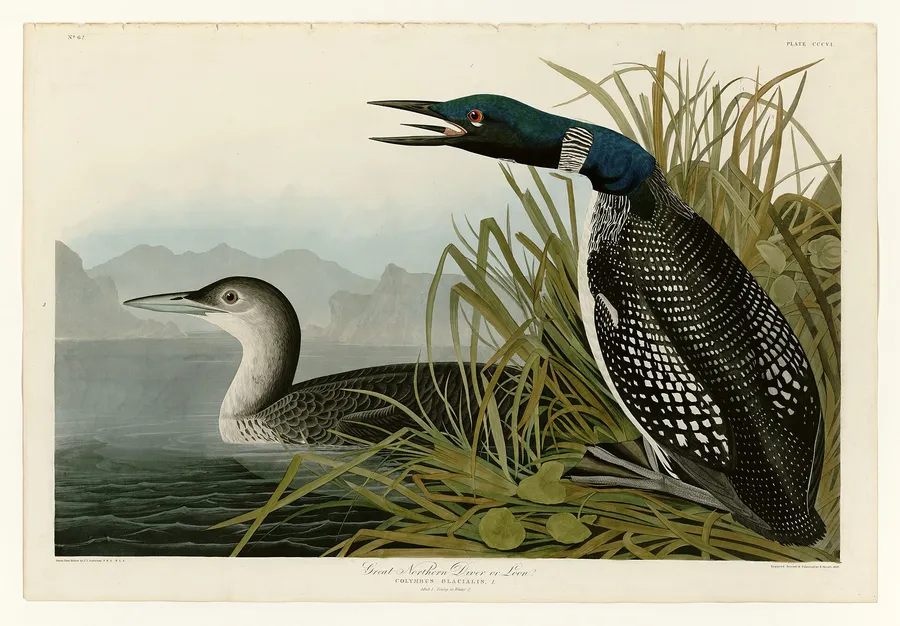
Common Loon
“Red-throated Loons nest further north than any other loon and prefer to nest on small ponds.”
Through the year
Columns that mention it, by the month they were published.
Year by year
Columns that mention it each year.
In his words
Ten of the 11 passages, oldest first.
Harlequin Ducks (Two Lights and Fort Williams, Common Eiders, at least one King Eider (Dyer Point), Black and White-winged Scoters (Crescent Beach), Pintails (Ferry Beach), Red-breasted Mergansers, Red-necked Grebes, and numerous Common Loons.
Speaking of ducks, fair numbers of Black and White-winged Scoters, Long-tailed, aka “Oldsquaw’s”, Common Loons and Eiders can still be seen without too much effort off Crescent Beach and rocky bluffs along Fort Williams State Park.
An interesting fact about loons is that once juveniles reach coastal waters on the ocean during their first fall migration, they will remain on the ocean for the next two years.
…a Herring Gull pilfering a Common Eiders hard earned meal (a mussel), two diving Horned Grebes, nine Black Scoters, six Surf Scoters, one male Long-tailed Duck, three Common Loons, one Red-breasted Merganser and one adult Bald Eagle that flew rather low along the length of the beach.
Later that same day on Trundy Point I spotted three Common Goldeneyes, the aforementioned Black Guillemot, two Harlequin Ducks, Common Eiders, a Common Loon, Black and Surf Scoters (aka skunk-headed coots) and nineteen Purple Sandpipers.
Later on the same day while walking along Ferry and Western Beach in Scarborough yielded 14 Common Loons, a Horned Grebe, a Red-necked Grebe and several Long-tailed ducks.
In the last days of February off of Dyer Point, Trundy Point, Pond Cove and Fort Williams I saw the following - Common Loons, Common Eiders, Harlequin Ducks, Long-tailed Ducks, Common Goldeneyes, Black and Surf Scoters and Red-breasted Mergansers.
Red-throated Loons nest further north than any other loon and prefer to nest on small ponds.
On this same outing I noted seventeen Common Loons, six Long-tailed Ducks a lone Horned Grebe and a single Sanderling foraging at the icy water’s edge.
In comparison to a Common Loon, Red-throated Loons are smaller, with visibly thinner bills that almost always appear slightly upturned, unlike the Common Loon’s thicker, straight bill that is typically horizontal to the water.
Show all 11 passages
In flight it holds its head close to the body, unlike a loon which stretches its neck forward and tips slightly from side to side, flashing its white breast and black back in alternating strokes.