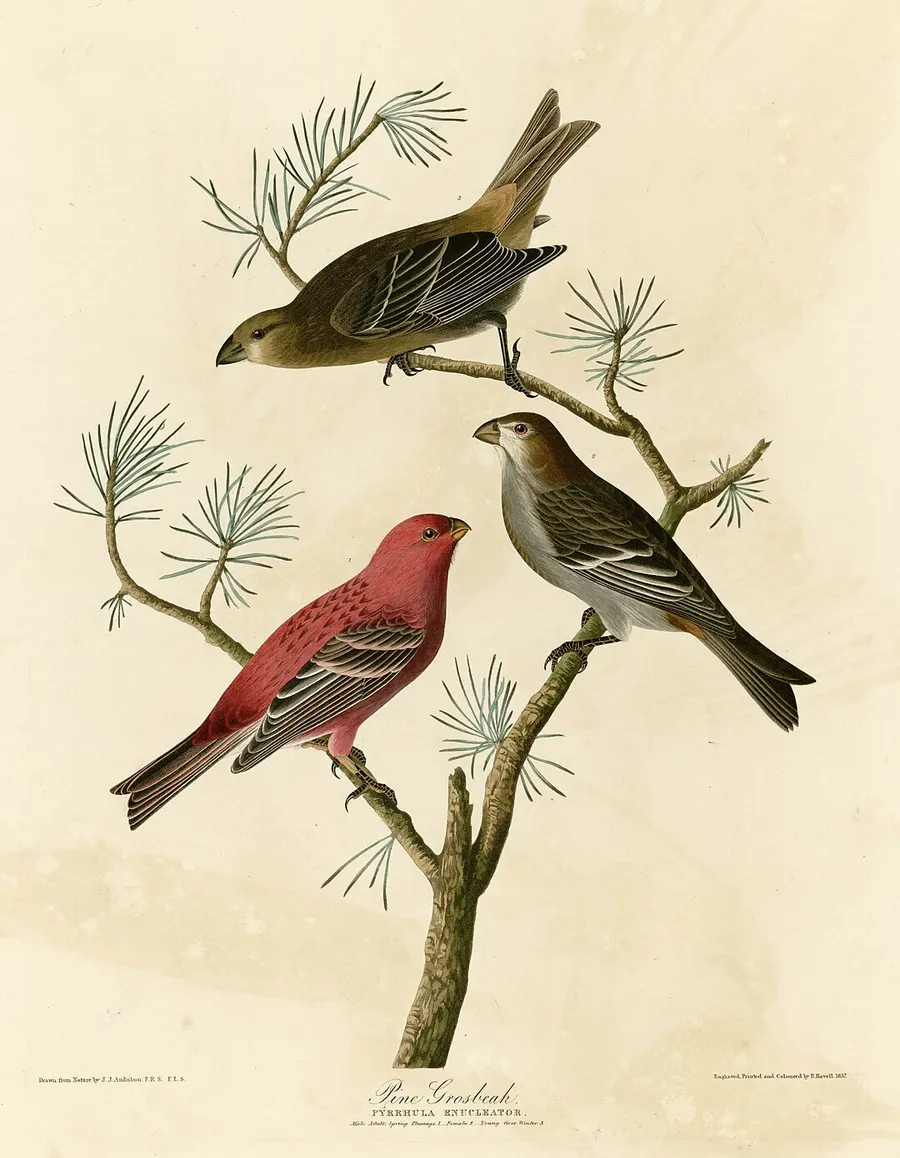
Pine Grosbeak
“In contrast, during the last days of December irrupting female and immature male Pine Grosbeaks could be found in fruit and berry trees across town.”
Through the year
Columns that mention it, by the month they were published.
Year by year
Columns that mention it each year.
In his words
All 10 passages, oldest first.
Other possible “snowbirds” include pine grosbeaks, pine siskin, redpolls, and both red and white-winged crossbills.
As of last year, this report has grown to include detailed forecasts for eight irruptive finch species, including Purple Finches, Pine Grosbeaks, Common Redpolls, Hoary Redpolls Red Crossbills, White-winged Crossbills, Pine Siskins and Evening Grosbeaks.
Inland, the winter finch irruption continues to unfold, yielding more and more reported sightings of Evening Grosbeak, Pine Grosbeak, Common Redpoll, Pine Siskin as well as White-winged and Red Crossbill.
In contrast, during the last days of December irrupting female and immature male Pine Grosbeaks could be found in fruit and berry trees across town.
On these last days of winter, the most northern, and last arriving of the winter finches from this past season’s noteworthy irruption (i.e., Redpolls, Pine Siskins, Pine Grosbeaks) are pushing back northwards to their boreal breeding grounds.
That said, on March 27 I flushed a single bird from the ground along the Willow Brook Trail that turned out to be a Pine Grosbeak.
Unfortunately, Pine Grosbeaks will largely stay close to home as excellent crops of Mountain ash berries are being reported from Lake Superior eastward.
In recent birding news, according to the 2022-2023 Winter Finch Forecast this fall and winter look to be a promising flight year for several species of boreal finch including, Common and Hoary Redpolls, Pine Grosbeaks and the elusive Evening Grosbeak.
Highlights from this year’s report include moderate southward movements of Pine Grosbeaks, Pine Siskins, and Evening Grosbeaks.
On a birding-related note, using eBird’s “search by species” feature for December through February 2026 shows strong numbers of Bohemian Waxwings and Pine Grosbeaks just to our north, west and downeast.